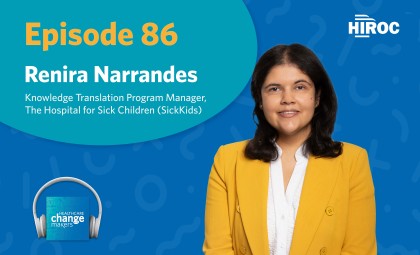
(Access show transcript) Renira Narrandes, Knowledge Translation (KT) Program Manager at The Hospital for Sick Children (SickKids) is helping healthcare leaders understand that KT is the missing link that can close the gap between research and practice.
Summary
Research analyst, communications expert, event planner, and video editor – these are just some of the many hats worn as a knowledge broker. Renira Narrandes, Knowledge Translation (KT) Program Manager at The Hospital for Sick Children (SickKids) and her entire team carry a diverse skillset to share and implement evidence that’s beneficial, easy to access and understand.
On this episode, Renira helps us understand KT better by breaking down what it is, what makes it unique, and how storytelling fits into it. Renira also shares the difference between KT and communications, a question she’s often asked.
We at HIROC loved learning how integral partnering, as well as sharing and scaling knowledge are to KT. These are, of course, essential to HIROC’s work in partnering to create the safest healthcare system.
In HIROC’s Community Corner article series, we take this conversation to the next level. Our latest article features the entire KT team at SickKids to learn about their program’s success and how they’re advancing healthcare safety.
Read the full article.
Mentioned in this Episode
Transcript
Imagine you could step inside the minds of Canada's healthcare leaders, glimpse their greatest fears, strongest drivers, and what makes them tick. Welcome to Healthcare Changemakers, a podcast where we talk to leaders about the joys and challenges of driving change and working with partners to create the safest healthcare system.
Michelle Holden: Hey, listeners. It's Michelle and Abi here from HIROC. Welcome to the first Healthcare Changemakers episode of 2026, and our 86th official episode. Time flies. On the episode, Abi and I talk with Renira Narrandes, program manager of the Knowledge Translation program at SickKids in Toronto. We haven't talked on the show about Knowledge Translation, or KT yet. So, I'm excited about this one. Abi, what are some things Renira shares?
Abi Sivakumar: Yeah, I'm excited too. Renira tells us all about Knowledge Translation, what it is, what makes it challenging, and how healthcare leaders and clinicians can better understand this field. All the questions you've had about KT will likely be answered this episode. Renira also tells us about her journey deciding she wants to work in KT. She shares a snippet of her poem, which touches on the expectations placed on her growing up. It definitely moved Michelle and me. You don't wanna miss it.
Michelle: That's right. It was moving. So, have a listen and don't forget to rate and review our show or share it with a friend. And now onto the episode.
Abi: Hi, Renira. Thank you for joining us. So, for our listeners, tell us a bit about yourself and where you work.
Renira Narrandes: Sure. Well, first and foremost, I consider myself a storyteller. But currently, I work as the Knowledge Translation program manager with the Learning Institute at the Hospital for Sick Children, also known as SickKids. And I hate to say the words knowledge translation and not explain what it is because in my experience, there has never been a time where I have said knowledge translation, or KT, and there hasn't been someone who doesn't quite understand what it is. So, would you like me to explain a little bit more?
Michelle: Yes, please. I would love that.
Renira: Okay. So, at the Sick Kids Knowledge Translation program, we do a lot of trainings on KT. And so, we define KT as this over encompassing term that includes two things. One is what we call dissemination and the other thing is implementation. So, dissemination is basically just sharing information or knowledge or evidence, but doing it in a way that makes sure that the evidence or knowledge you're sharing is easy to access, easy to understand, and that it's gonna be of benefit.
Now, even when I say those things, it probably still sounds a little bit vague to some listeners. So, let me just go a little bit deeper into some examples of what this actually means. So, thinking about, you know, making knowledge or evidence easy to access, just picture, like let's say, a very busy nurse who's on the unit. And all of a sudden, she's got a question she needs to answer. And it could be a question that hasn't come up before and she needs to find the answer. She may not have time, or likely does not have time to do a literature search or to, you know, find, like, oh, what's the current best evidence-based practice on this?
So, these are the kinds of questions and challenges that we as knowledge translation professionals, also known as knowledge brokers, try to address. And we try to make sure that when that nurse has that question at that time, we are able to provide that knowledge on the spot. So, that's just an example. You can think about, you know, how to easily access information in other ways. And then the next thing is making sure that knowledge is easy to understand.
So, if you've ever read a journal article or several journal articles, which I'm sure many people have, you might have noticed that there can be some jargon in there, right? Some very technical terms, some P values, some charts and graphs that I may not understand. And that's absolutely fine if you're trying to communicate that information to other researchers. But chances are there's other people out there that can benefit from that knowledge that you have. It could be teachers, it could be clinicians, it could be young people or patient populations. And if that's the case, we wanna make sure that we are shaping that information in ways that each of those audiences can understand. Okay, so that's the second component of it.
And the last thing is making sure that the evidence, the knowledge we're presenting, is going to be of benefit to people. As in the KT field, we like to think of this as relevance. So, you know, you can develop a research question, you can work on any project you want, but how do you make sure that what you're doing actually matters, that it's going to be relevant to the people that you're trying to help? We do this as knowledge brokers by talking to those people, by involving those people. So, we will actually, you know, think about, who can benefit from this knowledge? And chances are it's going to be more people than you think. So, we think about who those people are and we reach out to them and we try to involve them where it makes sense in a project. And when you do that, when you involve these people into your project, that is gonna help you increase the relevance of that work, which ultimately is going to make what you're doing more beneficial to people.
So, those three things kind of roll up into what we mean when we say dissemination. And then the second component of KT is implementation. So, let's say you have an intervention. It could be a care pathway. It could be, you know, you've got a peer support program and you wanna operationalize this in a setting, or perhaps it's something's already working in a setting and you want to expand. You want this to roll out in different settings. There's a lot of things that you need to think about in order to make this happen in the real world. So, that's what implementation is. And together those things form knowledge translation.
Abi: Thank you for breaking down KT so well and even giving examples. It'll help our listeners put things into context, this episode. And quickly shifting gears a bit with an easy one, Renira.
Renira: Yeah.
Abi: What was your first job ever?
Renira: Boy. So, does it have to be paid or not paid? Let me just answer for myself. I'm gonna say not paid. The first, or one of the first jobs, I would say. I used to give out books and newspapers at the Health Sciences Centre in Winnipeg. Fun fact. I grew up in Winnipeg. Yeah, that would be it.
Abi: Oh, that's a very full circle once since it was within science, too. And on that note, you have three master's degrees. Wow. Where does this desire to soak up knowledge and learning come from?
Renira: Well, I would say, like, this desire to soak up knowledge and learn is definitely part of it, but there's also this element of just sheer confusion, not knowing what to do with my life and kind of navigating. So, Abi, I'm not sure if I've told you my genesis story, but I've definitely told Michelle. So, maybe, you know, I'll tell your listeners my genesis story as well, just so that, you know, you can understand how one might end up with three master's degrees.
Abi: Yes, please.
Renira: Yeah. Awesome. So, I come from an immigrant family. I was actually born in South Africa, and we moved to Canada when I was 2 years old. And at the time, it was to escape apartheid, which didn't offend--it didn't end officially until, I think it was 1993. So, we moved. And if you, any listeners, come from an immigrant family, and if you happen to be, you know, of Asian or South Asian descent, you may have heard the message that, you know, you should be a doctor, or you should be an engineer. You should be a lawyer. In my case, because my father was a physician, he wanted me to be a doctor. I've actually written a spoken word piece about it. I won't do the whole thing for you now, but let me just tell you the first line. It goes like this:
I'm 16 when I tell my dad I want to write stories. “That's great,” he says. “You're good at it,” he agrees. And you'll have plenty of stories to tell about medical school. I try again. “Dad, I don't know if I wanna be a doctor like you.” My brother is sitting there, almost waiting for his cue. He says, “You know, if a man is dying, you can't save him with your poem. Do you think your pen can pump his heart and bring him back to life? Even a dying man isn't as tragic as you, excising Dad's immigrant dream with your metaphorical knife.”
I'll stop it there. But you get it, right?
So, you know, you come from this kind of background. You should be a doctor. So, that was the message that I had. And I started off, you know, undergrad in health sciences. And then something I didn't expect happened. Something out of nowhere that kind of changed my life and my family's life forever. And that was one summer, I think I was in third year university. My dad got into a freak accident and he passed away. So, after that happened, you know, I was thinking and I thought, “You know what? Maybe I'll apply to medical school. But for right now, I'm gonna do a master's in journalism because I love writing. I love, you know, thinking like an investigative journalist. I love public speaking. Maybe I'll go into radio, I don't know. But I know that I'm really passionate about this area.” So, I did my master's in journalism.
But you know what? That voice doesn't go away. The voice that says you should be a doctor. It doesn't go away right away, and I don't think that that voice ever goes away until you feel like you've arrived. You feel like you've, you know, arrived somewhere that you're meant to be. You feel like you've arrived somewhere where you're proud of yourself. Until that happens, that voice, I don't think it goes away fully.
So, as you can imagine, as a young person, early 20s, just graduated from a new program. I wasn't quite at that place just yet. And so, that voice was still there. So, I said, “You know what? Let me get back into healthcare.” And I discovered the field of occupational therapy, or OT. I thought it was really cool because it's kind of--it shifts away from the biomedical model. And I really like how it put patients or clients at the centre of care, and it looks at them as a whole person and also considers, you know, how does the environment that this person is in affect their health?
So, I loved that theoretically. But in practice, you know, I realized, I don't think, you know, I wanna be an OT. Now, don't get me wrong, there is nothing more fulfilling than helping people. And, you know, being a frontline provider, getting, you know, that immediate fulfillment, there's nothing like it. You know, there's no Excel spreadsheet. There's no presentation, no strategic document. Even, you know, you may help your co-workers, of course, but nothing, at least for me, compares to that feeling of helping people.
So, it was actually quite difficult to move away from that. But inside, I knew there's a storyteller in me. There's something else I meant to do, and it is not this. Of course, I didn't know what it was really, but I had taken a course within OT on the social determinants of health. And I became fascinated about, you know, this concept that our health is affected by all these other things that we can't even control. Things like gender, race, ethnicity, employment status, income, where we were born, geographical location, our access to grocery stores. All of these things can affect our health. And I thought that was, you know, really fascinating. Is it similar to OT, you know, taking a more holistic view of a patient? Yes, but I wanted to take more of, like, a population-level look at this. And so, I did my third master's. I don't know if I mentioned, but OT was a master's in science. That's the second one. So, then I did my third master's in public health at the University of Toronto. And that, my friends, is how one person can end up with three masters. I don't think that any child grows up thinking, you know what I want to do with my life? I wanna do three master's degrees and be confused and try to navigate. I don't think that happens. But when it does, hey, you just got to go with the flow.
Abi: Oh, my gosh. That snippet of your spoken word was amazing. And I really appreciate you sharing your story and even touching on the immigrant or immigrant parent experience, which is something that I personally resonate with.
Renira: Thanks, Abi. Yeah, you know, I would love to hear your story, but I know that we can't do that today on this podcast, but maybe another time.
Abi: Of course, yes.
Michelle: I would love to hear all of the stories. That was really amazing. Renira, I wanted to know if it's okay, what do you think that your dad would think now about kind of where your career is at?
Renira: Oh, absolutely. Without a doubt, he would be proud. Because you know what I think, you know, that generation of parents, they couldn't necessarily see the opportunities that we have today or couldn't conceptualize of a life that's different from that. Especially, you know, growing up in South Africa at that time, there were probably only a few pathways to success. But today, that's not the case. And definitely living in different parts of the world gives you access to other opportunities as well. So, quick answer. I know he would be proud of what I've done.
Michelle: I can only imagine. Yeah, for sure. So, you chatted a little bit about your education, the three masters. Yeah, that is wild and very impressive. I want to talk a bit about your career. And when we spoke last, you let me know that some of your early days in this field were at CAMH. So, I was wondering if you can share that with our listeners.
Renira: Sure. Yeah. I would say the role that I had at CAMH was foundational to my understanding of knowledge translation. In fact, everything that I learnt about KT, I learnt in that role. And it's the same stuff that--or at least part of the things that I teach now at SickKids. And I was quite fortunate, actually, because I joined at a time when there was a new research centre that was just starting up. So, donor funded for X number of years. It might have been eight, don't quote me on that, but around eight years. The centre specifically was the Cundill Centre for Child and Youth Depression. So, if you can imagine, you know, any new research centre has a lot of work to do. Everything is new. Right now, obviously, people joining the centre come with different experiences. You know, you have connections. It's not like everything is brand new, but a lot of things are brand new.
So, when you have a new research centre, of course you have to develop a logic model, a vision, a business plan. You've got to hire people. You've got to figure out where are the research project is gonna come from, you know, for our centre, how is the funding going to work. And a piece of that as well is the knowledge translation piece. At the time, I'm not sure that anyone really knew exactly what knowledge translation was, including myself. But I think the centre knew that it wanted to develop tools that clinicians could use in practice, or it wanted to do things that would have an impact, which is kind of, you know, what KT does. But no one could perhaps articulate exactly, you know, what KT is.
And so, I got into that role and I had to learn the ropes because there was no one really who knew that much about KT. Now, of course, I had support. My team members, the director, everyone was super supportive in that role. But I think there's a difference between support and having guidance and mentorship from someone who's from your field, which is what I didn't have. So, I had to navigate. I had to learn how to do KT.
And over time, I created this kind of circle or this framework of what KT is. And maybe I'll just describe it to you because I think it does a good job of explaining what I did in that role. But the other thing that it does is it defines what a knowledge broker does a little bit more for people out there who even after hearing my definition, may still not quite understand, like, what do knowledge brokers do in practice? So, I'll just describe this framework that I developed. And it's by no means like a definitive framework of knowledge brokering. It's not even published anywhere. It's just something, sort of way for me to conceptualize of what a knowledge broker might do.
So, if you can close your eyes if you like and just picture this circle. I don't know why I said close your eyes. It doesn't really make a difference. So, there's a circle and there's four quadrants. One of those quadrants is what I call, like, products or tools. And this is where we develop things that are going to make our knowledge and our evidence easy to use in practice by the people who need to use that knowledge. So, an example might be like a two-page decision aid that summarizes a much longer clinical practice guideline that, you know, a busy clinician may not have time to read. Sorry. And then, that's just me coughing. And then that two-page decision aid also became a larger project where we developed an interactive care pathway. It's like a separate website where, you know, you can click on the care pathway. These boxes will open up and give you more information. And we also develop things like a quick guide to assessment tools, various different videos that we co-developed with young people and other partners. So, that's an example of products and tools.
Another quadrant is partnership. And, you know, you may think, well, don't we all kind of work with partners in our roles? Probably, I would say you're right. But I think the difference is in KT, we actively think about partnership because as I--I think I mentioned before around the relevance piece, right? Like, we like to engage different knowledge users, different audiences in the work that we do to make it relevant and therefore beneficial. And in order to do that, you need to build partnerships with people. So, if you're developing something specifically for dieticians or coaches, you're gonna want representatives of those people on some kind of list so that you can consult them and get their advice. So, partnerships is part of it.
The other quadrant, or another quadrant, is what I call knowledge translation activities. So, those are things like, you know, I would develop workshops or organize scientific retreats for the researchers at the centre, organize large international conferences, which I did a couple of times, of course, with help from others, and then I would put implementation projects into that quadrant as well. So, I worked on a project where we took a care pathway developed at the research centre, and we implemented it with a family health team in Ontario. So, that's activities.
And the last piece is communications. And you know what? Like, I think one of the most frequently asked questions in our KT trainings is what is the difference between KT and communications? I'm not sure my description of this quadrant will fully disperse or explain what the difference is, but might help. So, you know, I worked very closely with the communication manager at CAMH. We would meet every two weeks. I would give her the lowdown of all the research projects happening at the centre, whether anything is newsworthy. She would help develop press releases when there was something that was newsworthy. She would, you know, help edit certain video scripts, give, you know, the final green mark from the communications department, support, you know, strategic development, our website, and things like that.
So, I just wanted to describe that circle because I think it gives you a good idea of what knowledge brokers might actually do in their roles. And also to say, you know, coming back to, you know, my enthusiasm about that role, like I said, it was foundational because I did a lot in that role. I had a lot of responsibilities. And as I said, everything I know now, I think I learnt in that role. So, I'm incredibly grateful that I had that opportunity to go through that circle and all of those different quadrants.
Michelle: Even just you describing the quadrants makes me feel that that role was huge. Like, it was, yes, foundational, but also so much that you were involved in, as you said. Like, I can even tell just from hearing that. And I also appreciated the communications piece and you saying, working closely, as Abi and I are communicators. We always encourage our colleagues to reach out to us. We like those, like, regular touch points. Not just, hey, I'm starting this project. But, like, what are you working on? What are you thinking about? So, I mean, to have that relationship is really good. So, I'm happy you mentioned that.
Renira: Yeah. And wouldn't your life be easier if you had, like, a go-to knowledge broker who could represent a bunch of different, like, researchers or other people?
Michelle: Yes, yes. I need a knowledge broker in my life.
Renira: Don't we all?
Michelle: I never knew I needed one until this conversation. Abi, remind me next week that we need to find one. Okay. I wanted to kind of speak a little bit about your role now at SickKids and the knowledge translation program, sort of what makes that program so world-renowned.
Renira: Yeah. Well, I think for anything to be world-renowned, there is more than one thing that needs to happen or be in place. So, I think in our case, it would be having just a good quality product. Like, we have good quality trainings, good quality tools that are informed by evidence that have been developed over years from people with different levels of experience and expertise. That's one thing. And then just the enthusiasm of the staff that work in our program is another thing. And then the reputation of SickKids.
So, I think all those things can come together or do come together to form the program that we have right now and the success that I think it is. I can go in a little bit more detail about what I think it actually is. I think, you know, when it comes to our trainings, SickKids was a pioneer in the field. I think the first knowledge translation training was developed somewhere around 2004 and 2008 by Dr. Melanie Barwick, who is one of the co-founders of our program, also a senior scientist and a Canada research chair in implementation.
So, in that time period, she had received a grant to look into, you know, what does knowledge brokering look like for a pediatric healthcare centre? And also, you know, what might training look like? And it was an important question because in the early 2000s is when that need for kind of KT training and building capacity kind of came up because the Canadian Institutes for Health Research, or CIHR, started to become more interested in knowledge translation and start to require different research projects to have KT plans. And so, you know, if you're requiring something like that, you need to build capacity.
And so, that's how the initial training was born. And then, since then and over time, it's been informed by new evidence. We've reiterated it. We recently included a new module on equity, diversity, and inclusion in KT in one of our programs. So, you know, being a pioneer, having the years of experience, having different people come on, we've also had a great international reach. One of our KT programs has been licensed to an organization in Australia. So, it gets run there. We also recently did a customized training for an organization in Africa that supports other organizations all across Africa in different countries. And just last year, we hosted a visit by a knowledge translation program from the Middle East, who had just started their program in 2022. And they had come to us for training and support. And we've since trained their director and I think all of their KT staff.
So, I think, you know, when you have a good quality product, people see it. And it's been the case internationally as well. We've had, I think, people from somewhere around 20 different countries come to take our trainings. Our workshops are really fun too. Like, I think they're fun anyway. Our staff are really enthusiastic, and I think that also plays a role in the success. We're also, I believe, a pioneer in the knowledge translation tools that we've put out there. We have a very specific one that if anyone out there is interested in developing a knowledge translation plan for a project, we have a tool, you know, it's on our website. It's free that you can download. It's called the Knowledge Translation Planning template, developed in 2008 by Melanie. And it has been widely used across Canada and beyond. In fact, we've translated it to French, Spanish, and Portuguese with different partners around the world who had used it in English and thought, you know what, it might be helpful to have this in a different language in my country. And so, we've done all those translations. So, there's that.
And then, of course, as I mentioned, the reputation of SickKids recently been named the number one pediatric hospital in the world. Pretty cool, right? And definitely, I think plays a role in that international reputation of our program. Although I will say that a lot of people who come to our courses, they come to us through word of mouth, which I think is the best place to come from because it means that someone has taken your training or used your tool and they really liked it. And so, they're starting to refer other people.
Michelle: That's a really good overview. And I also wanted to say, I was going to say the Knowledge Translation Planning template, we can put that in our show notes so that we can share that as well. So, it sounds really--it's really practical. And we'll check it out as well and for our different subscribers and our listeners. So, thank you.
Renira: Cool. Yeah, that'd be awesome.
Michelle: When we last spoke, you told me that it's difficult to be a good knowledge broker without being on the ground and doing the work. So, that there's no guidebook for this work. I just wanted to know what makes KT so challenging?
Renira: Yeah. I think there's a few things. So, one thing--so as I mentioned before, like, when I started my role at CAMH, it was--I didn't really have someone else who had a lot of KT knowledge that I could go to. And so, it can be a lonely feeling. And I know this is the case for a lot of other knowledge brokers across Canada because they come to SickKids to get trained and they will tell us this. They say, I feel lonely. I'm so glad to be in this training because there's like 20 other people here who are doing what I'm doing. And it just feels very reassuring.
So, I think just the fact that some people will be the only person doing what they're doing in their team or in the department, sometimes even in an entire hospital, that can be very lonely. And another thing that's challenging is that context can be very, very different, right? Things can be very complex. Maybe you're working on a topic where there's a lot of research evidence, there's a lot of knowledge we have about that topic, and that can make your life easier, right? Or maybe you are working on a topic where there isn't a lot of evidence, and then that becomes really challenging. Because how do you develop tools or make recommendations when the evidence is still emerging? It's become a very fuzzy grey line. And I hear about it a lot from knowledge brokers that sometimes, they're just not sure. Like, you know, in KT, we're meant to kind of share this knowledge and do it in a creative way. But how do I do that if I'm not too sure if the strength of evidence is there, right? So, that can be very challenging.
You know, you might be working at a large academic centre hospital like I am at SickKids, and you can have access to all these great resources and people that can help. Or, you know, maybe your next role is in a small non-profit and you don't have the same opportunities, the same access to resources. So, that can be challenging. If you switch roles from that area to the other area can be very, very challenging. But I will say that despite the differences, there is a kind of standard approach or just a way of thinking like a knowledge translation professional that you can learn. And it involves asking questions like, why are we doing this? What is our goal? Who needs to be involved? What don't we know about this topic? Is there anything else we need to explore? And I know those sound like very, very simple questions, but you'd be surprised how often I've been at tables where those questions are not asked. It happens all the time.
And so, as a knowledge broker, you really learn, like, how do I get information? What do I need to ask? One of the biggest lessons of our training is that you should always focus on why you're doing what you're doing, because I think we tend to jump to strategies right away. Oh, you know, let's do a two-minute video. Let's create a poster or a plain language summary. Let's host a conference. But you really need to take a step back and ask yourself, you know, as an organization or a team or a department or a project, what do we actually want to accomplish? And it could be that the strategy you've already chosen does not align with the goal that you have.
And then also, like, what makes it challenging, I would say like as a knowledge broker, you need to have a very broad skill set. So, if you remember that circle with all the different quadrants, right. That's a lot. There's a lot of different things that you need to do. Like maybe one day, you need to be a research analyst because you need to have the ability to understand the research, to know what's going on, to read a paper and be able to make sense of it, right? The next day, maybe you're a communications expert because you need to develop key messages about a few different projects. The next day, maybe you're an event planner because you're responsible for a large conference and for the success of that conference. The next day, you know, you're a video editor because you're in charge of producing this video. The next day, you know, you just need to flip a different switch and talk to a CEO. And then the next day, you're talking to a young person. The next day, you're talking to a clinician, right?
So, you really need to have a diverse skill set, which is another reason why I think this role can be very challenging. I do always say, always say that I think there's really four skills that are critical to the success of good knowledge brokers. And one of those would be communication, right? You need to know how to communicate to different people. Why? Because people are important, relationships are important. So, the second thing is you need to be able to build relationships. The third thing is you may wanna be a little bit creative because KT is a very creative field. We're often making videos. Maybe you're developing a play or a song or, you know, you're working with young people who have all sorts of creative strategies. So, being creative is one.
And then the last thing, and perhaps the most important thing, is critical thinking skills. You need to be able to read between the lines, to see, you know, what's going on. Not just on a project, but, you know, perhaps in the politics behind the project. You also need to have the confidence to ask tough decisions when--or to ask tough questions--sorry, not decisions--in a room full of world-renowned experts. So, let's say you're at a table and, you know, you're surrounded by these experts and they've all unanimously agreed on something. If you have even the smallest doubt about that decision, you know, you need to be able to put your hand up and ask whatever question you wanna ask or just point out what you wanted to point out. And you don't get there without that skill of being able to think critically. And of course, it's not something that most new knowledge brokers have right away. I definitely didn't. But it is something that I would say I've developed over time.
Michelle: That's challenging but also exciting, just the way you describe the day-to-day. Like, you know, one day you're doing this, one day you're doing that. And these are the kinds of skills you can pick up. Yeah, it's a big role, as I said. I was wondering if you had, like, a very short elevator pitch in the elevator with a CEO as you mentioned, and you have to pitch KT or say, you know, talk about why it is so important. And you've mentioned a lot of the aspects. But what are you hoping that healthcare leaders understand about it?
Renira: I'm hoping they understand that knowledge translation is the missing link. That, you know, it can take 17 years on average to take what we know in research from evidence and to apply that to practice. So, knowledge translation is the field that can help you close that gap.
Michelle: That's a good one.
Abi: Calling all art lovers and appreciators. We can all agree that art is central to understanding human experience and can provide valuable insights into innovation, leadership, and strategy. HIROC's new strategic plan, the Art of Safety, pulls from both the art and healthcare worlds. It leans into the idea that each person in the Canadian healthcare system has unique skills and talents that are valued. Most importantly, each is a gifted professional, or better yet, a unique artist who is there for their community. Learn more about the Art of Safety by heading over to hiroc.com, or by clicking the link under mentioned in this episode. Enjoy the episode.
And Renira, I was wondering, how does storytelling fit into knowledge translation?
Renira: Yeah, great question. So, storytelling fits into everything. And I'm a little bit biased because, as I mentioned, I'm a storyteller. I've been teaching storytelling for almost 10 years now. And a few years ago, I licensed my storytelling workshops to SickKids. So, I run them at SickKids twice a year, once online, once in-person. So, just to say, I'm very biased because I believe stories are so, so important and that they affect everything and fit everywhere. But anyway, to answer your question more specifically, as we talked about knowledge translation requires sharing knowledge, right? And if you're sharing knowledge with somebody or evidence, you have to do it in a way that's clear, that makes sense to people, right? And storytelling can offer you that clarity.
In fact, I have a line in my poem, the same poem I started earlier where I'm talking to my dad and I say, dad, words are like paper planes that launch from a tongue. Don't shape them well, but then don't be stunned when they fly 2 inches before they plunge. Why can we only fold planes and tell stories when we're young? So, the point there is that the words we choose are important. The way we put sentences together, put arguments together, put our presentations together is important. And that's because, like, our brains need a structure. We actually understand information in the form of a story first. And if information that's being delivered to us is disorderly, if it doesn't make sense to us, we will zone out. Or even worse, we might make our own interpretation of that information. So, storytelling offers us, through story structuring, a way to shape information in a way that other people's brains need to understand it. Okay. So, that's one thing.
The second thing is that knowledge translation is going to require you to influence different audiences. Why? Because, you know, chances are you have a message that you want people to adopt. Or if you're working on an implementation project, you need to get buy-in into that project. And even after you get buy-in, the need to tell the story doesn't change. You know, more people might come on that project or new people join your project, or the story of your project is going to change, especially as you expand or different things happen. And so, you need to be able to articulate the story of what you do in a way that's gonna resonate with different audiences in order to create that buy-in.
So, do I think stories on their own can bridge that gap that we talked about between knowledge and practice? No, of course not. Because there isn't any single strategy that can do that. Change is hard, right? Whether it's practice change, policy change, behaviour change, it's difficult. And you're going to need a multi-pronged strategy. But I do think that storytelling is a very important first step and also something that's going to be important throughout the entire process.
Abi: I love how you speak about and explain the importance of storytelling. So, I'll ask another question on that topic. We're seeing a bit of resurgence in long-form media like podcasts or articles in a world where we're still being told attention spans are limited and we should keep content short. So, what is it about these longer form mediums that help those of us in healthcare communications drive that information and really make stories stick?
Renira: Yeah, that's a great question. I will say first that I think we need both. I think there's definitely a role for shorter form media. And one of the things it can do is drive you towards a longer form type of media. Or sometimes, you know, you have a very simple goal. Like, maybe you just want to raise awareness of a conference that's coming up, and maybe a simple quick poster on social media will do. So, it's definitely a time and a place for short form media, but long form media can do other things. And, you know, maybe I'll explain this using a concept that I use in my storytelling course. It's actually by Aristotle, ancient Greek philosopher.
So, Aristotle says that if you want to convince someone of something, there are three things that you need. Ethos, pathos, and logos. So, pathos is emotion, right? Big part of storytelling. Emotion is what connects us to each other, helps us to understand different things, to understand experiences, a very important part of storytelling. And you will have much more time to express emotions in a longer form type of media. Can you have emotion short-form media? Absolutely. Of course you can, right? Maybe you see an image that's really jarring, right? Right away, there's emotion. Or, you know, maybe you see a reel that makes you really sad. Right. That can absolutely happen. But good storytelling, when it comes to emotion, it doesn't keep you on a high the whole time, and it doesn't keep you on a low the whole time. Good stories move your emotions up and down to keep you engaged. And that really helps you to understand more kind of complex information and keep you engaged throughout the whole process. So, that's pathos.
The next thing, ethos, is credibility and trust. So, again, can you have trust in a short form of media? Of course. Think about your logo. In my case, maybe it's a SickKids CAMH logo. Whatever the logo is at your organization, that can convey trust and credibility, right? Yes, but not always, because that trust and credibility doesn't always translate to different audiences. For example, I've worked with people in community who perhaps they've had a negative experience at a hospital. And all of a sudden, they don't trust anything coming from that hospital. So, when you have a longer form of media, you have more of an opportunity to tell your story, to perhaps address any misconceptions or any misinformation. You have an opportunity to build trust. Now, granted, you know, with some audiences, trust can take decades to build. So, a podcast, you know, may not do it, but it will give you more time to tell your story.
And then the last component is logos, which is logic or reason. So, when you have a longer form of media like a podcast, you have more time to let your argument unfold, to put the facts together. And it also signals to people that, hey, you know, this topic is important. It's not something we can address in 30 seconds. And it lets you explain the information because complex topics which, as you know, will occur in healthcare sometimes will require more time to explain.
Abi: Thanks for speaking on this. I just have to say, I love how you break things down using examples or a quote or a poem or a quadrant. But yes, I feel like long-form media is underrated or underappreciated now more than ever. But like you said, both can be used depending on the time and the place.
Renira: Yeah, absolutely.
Michelle: I know, I appreciate it too. All of the examples that you give just make us kind of--it really, as you said, like, it helps the story, helps describe what you're trying to tell us and teach it to us and help us stick in our brain. So, it really, really helps me. Clearly, you're a very good speaker, a very good storyteller. I wanted to ask you, Renira, if you had to deliver a presentation on anything, it's not KT and it's not work related, five minutes without preparing at all, what topic would you choose? Could be anything else.
Renira: Follow your dreams. It would be all about the importance of following your dreams. Because I feel like that is one of the main themes of my life, as you know from my genesis story.
Michelle: That's true. I love that. That's a good one. I'm gonna flip it over now to Abi. You've taught us so much already, but we wanna ask you a few more questions. A few easy questions. We call it our Lightning Round, and then we will let you go and we will--we hope our listeners have learnt so much. I know I have.
Abi: Renira, can you name one book that has impacted you?
Renira: So, I feel like I keep going on and on about follow your dreams, but I would say The Alchemist because that's the message of the book. Follow your dreams.
Abi: That's an amazing one. And what's your go-to hobby when you need some downtime?
Renira: I actually--so, I know some people might not consider this downtime, but I love to meet up with friends or family and just have really great conversations.
Abi: Love that. And what or who can make you laugh without fail?
Renira: My little brother, specifically conversations we have together. We have the same personality type. I have three siblings. And I would say my older brother and my younger sister are in one zone, and then myself and my little brother are in another zone, and yeah. Yeah. Together, I think--well, I personally think we're hilarious, but maybe other people don't.
Abi: Okay. And we're early into the year. Do you have a resolution or even something you want to stop doing?
Renira: You know what? I think so. I just came back from Cape Town. I was in--so, I told you I'm South African. I was in Cape Town in December, and I did a storytelling talk at the University of Cape Town. And the number of students who came up to me with messages of gratitude was so inspiring that it got my brain to think, like, you know what? I want to do more in South Africa or in Africa. What that looks like, I don't know. I'm not sure. But it's just something--it was a feeling that I was left with at the end of 2025 that I still want to explore. Maybe has nothing to do with storytelling. Maybe it means, you know, I want to go back to my roots a little bit more. I want to see my family who's down there a little bit more. I don't know what it is, but something to do with that.
Abi: I love that resolution. And clearly, your trip, something, you know, spoke to you or resonated with you. So, I'm glad it left that impact on you. And lastly, finish the sentence. If I wasn't a knowledge translation, I would be doing--
Renira: Stand-up comedy.
Abi: You'd be good at that. You're a great speaker. So, I feel like your jokes would definitely land. Well, thank you so much for sitting down with us, Renira. It was a pleasure hearing your story, getting to know you, and of course, learning about KT.
Renira: Thanks so much, Abi and Michelle. I had a great time and I wish we could keep the conversation going 'cause I know we all have stories and I know all the listeners also have stories. So, wouldn't it be lovely if, you know, we could have some kind of big story time or something like that?
Michelle: I know, I think so too. I think we'll have to keep the conversation going in some way after this. So, maybe we'll hear from you again soon. But I loved it so much. Thank you, Renira.
Renira: Oh, thanks, Michelle. Thanks, Abi.
Thank you for listening. You can hear more episodes of Healthcare Changemakers on our website hiroc.com and on your favourite podcasting apps. If you like what you hear, please rate us or post a review. Healthcare Changemakers is recorded by HIROC's communications and marketing team and produced by Podfly Productions. Follow us on Twitter at @HIROC Group or email us at [email protected]. We'd love to hear from you.