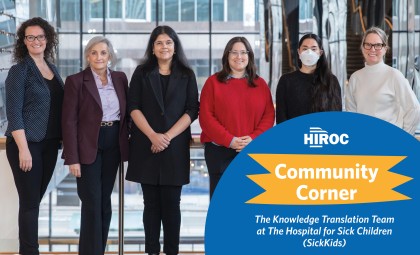
Our Community Corner series amplifies HIROC Subscriber voices and the important work they are doing to make a positive impact on the Canadian healthcare system. Each edition of Community Corner focuses on a topic that is top of mind right now from experts in the field. We ask the questions you’ve likely been wondering about!
Renira Narrandes, Knowledge Translation (KT) Program Manager at The Hospital for Sick Children (SickKids), was just featured on our Healthcare Change Makers podcast. We loved hearing Renira’s expert take on what makes KT unique and how healthcare leaders and clinicians can better understand this field.
After the episode, we wanted to scale even more learnings on this topic and keep the conversation going!
So, on this edition of Community Corner, we chat with the entire KT team at SickKids to learn about their program’s success and how they’re advancing healthcare safety.
If you had to give an elevator pitch, what is KT?
There is often a gap between what we know works and what happens in practice. KT, which encompasses dissemination and implementation, addresses this gap.
Dissemination involves processes and strategies designed to ensure that evidence is accessible, understandable, and beneficial to a range of knowledge users.
Implementation science studies the methods and strategies that can promote the uptake of research findings and evidence-based practices into routine healthcare, policy and organizational settings. It’s important because even the best research and innovations can’t improve outcomes unless they’re effectively adopted and sustained in real-world settings. Implementation science helps organizations identify barriers, design solutions and measure impact—ensuring that proven interventions truly benefit patients, providers and systems. In healthcare, this means safer, more effective care for everyone.
Tell us about the KT Program at SickKids and how it got started.
In the early 2000s, the Canadian Institutes of Health Research placed great importance on KT and required scientists to attach a KT dissemination plan to their research proposals. As the concept of KT was new, there was a need for a professional development program for researchers.
The KT program at SickKids emerged from Dr. Melanie Barwick’s research program, with a project funded by the Canadian Health Services Research Foundation (2004 to 2007) to explore the role of knowledge brokering in paediatric healthcare and to develop a training program for researchers. With the funding, we did two things:
- We established the first Knowledge Broker role at SickKids.
- We developed the Specialist Knowledge Translation Training program. Initially intended for SickKids scientists, other health research funders and organizations got wind of it and invited Dr. Barwick to teach the course across Canada.
To further advance Dr. Barwick’s work and enhance KT capacity at SickKids, the organization created the KT Program as part of the SickKids Learning Institute. Other resources and courses followed, including the Knowledge Translation Professional Certificate in 2010, and the Planning for Implementation Practice workshop in 2019.
Since the launch of our first KT training in 2008, we’ve facilitated more than 100 sessions for more than 2,000 participants from 15+ countries. Our Knowledge Translation Professional Certificate is a unique opportunity for KT professionals and is accredited by the Continuing Professional Development Office at the University of Toronto’s Temerty Faculty of Medicine. It’s also recognized as a Leading Practice by Accreditation Canada.
Tell us about the team behind the program.
The KT Team plays a huge role in the program’s success. A combination of broad KT knowledge, research skills, administrative expertise and leadership advocacy makes our work possible.
Renira Narrandes, KT Program Manager, and Francis Routledge, KT Specialist, are dedicated to furthering the work of the program, including teaching, providing KT consultation and managing program operations.
The team also includes Dr. Barwick, Senior Scientist, Child Health Evaluative Sciences (CHES), Andrea Chiaramida, Administrative Coordinator, CHES, Kelly McMillen, Executive Director, SickKids Learning Institute, and Kelly Warmington, Manager, SickKids Learning Institute. Members of the team teach courses, provide important operational input and contribute diverse perspectives on the program’s direction. Everyone works together to build on the program’s success and innovate to make the program the best it can be.
We understand the program has garnered national and international attention. Congratulations! Can you share the secret sauce behind its success?
A number of things come together to make the program successful. Our team is experienced in, and knowledgeable about, a range of KT topics, including implementation, storytelling, and accessibility. We all come from different backgrounds—psychology, neuroscience, occupational therapy, journalism, cinema, education, public health and others! This brings diverse perspectives to the table, enabling us to incorporate learnings from various fields into our programming.
We also have a strong foundation as the KT Program is housed within the Learning Institute at SickKids. This gives us access to other high-quality programs and services and enables collaborations that enhance our program.
Over the years we’ve developed several KT tools, including the widely used Knowledge Translation Planning Template, which has been translated to French, Spanish and Portuguese. We’ve adapted our trainings and tools over time to include new evidence and to respond to feedback from participants. This continuous evolution has resulted in high-quality offerings that are used globally.
There continues to be a national and global need to improve the way we share and implement evidence. This requires a workforce that is trained in KT and that has access to KT tools that work. We are proud to play a role in enhancing KT at SickKids and around the world.
So much of what we do at HIROC is around sharing knowledge and connecting Subscribers to help organizations across Canada increase healthcare safety. How does KT help advance healthcare safety?
KT helps advance healthcare safety by ensuring that the latest research findings and evidence-based practices, including interventions that improve patient outcomes and safety, are strategically shared and adopted in routine healthcare settings. This process closes the gap between what is known to work and what is done in practice. Collaboration with end users is an important concept in KT.
For example, if you’re designing a safety program for nurses, you might invite a few nurses to provide input on your project, or even to co-develop a tool with you. This results in outputs that are grounded in real-life needs and experiences, thereby making them more relevant and likely to be used. KT also fosters a culture of continuous learning and improvement, connecting healthcare professionals and organizations to share best practices and lessons learned.
What advice do you have for smaller healthcare organizations who may want to pull on some best practices around KT to advance their work?
Organizational size isn’t as important as a comprehensive and structured approach to KT. Both dissemination and implementation can be approached in this manner, using tools and trainings our team has developed at SickKids.
When searching for KT resources or topic-specific examples of KT projects, remember that not everyone refers to their work as KT. Many individuals and organizations use terms like “knowledge mobilization,” and closely related fields such as education, communications, and community engagement often overlap with KT.
Many KT projects are not published in scientific journals! You might try exploring resources from other sources, such as KT hubs (for example, some research teams might publish the tools they’ve developed on a separate website or page).
What is it about KT that drives you to continue doing this work?
The answer is different for each of our team members! Here’s what drives Francis: “Three major themes inspire me to continue working in this field: a passion for learning, a commitment to community engagement and an appreciation for the dynamic nature of KT.”
Meanwhile, Andrea says: “I’m continually impressed by the high level of engagement and commitment from our participants. The strong interest in our program across diverse audiences highlights the growing demand for KT learning and reinforces the value of the knowledge we provide.”
Thank you to the team for sharing what it is that makes KT at SickKids so successful, and how it continues to drive innovation around sharing and scaling best practices in healthcare.
Don’t forget to listen to our one-on-one Healthcare Change Makers interview with Renira, where we talk more about KT. Renira even shares part of her origin story with our listeners!
If you have a story for Community Corner, we’d love to hear from you. Subscribers can reach us at [email protected].
Contributors from SickKids:
- Melanie Barwick, PhD, CPsych
Senior Scientist, Child Health Evaluative Sciences, The Hospital for Sick Children
Tier 1 Canada Research Chair in Implementation Science & Practice - Renira Narrandes, MA, MSc(OT), MPH
Knowledge Translation Program Manager, Learning Institute, The Hospital for Sick Children - Kelly Warmington BScH, BEd, MEd, PMP
Manager, Learning Institute, The Hospital for Sick Children - Kelly McMillen BPHE, BA, MBA, PMP
Executive Director, Learning Institute, The Hospital for Sick Children - Francis Routledge, MSc
Knowledge Translation Specialist, Learning Institute, The Hospital for Sick Children - Andrea Chiaramida, BA
Administrative Coordinator, Child Health Evaluative Sciences, The Hospital for Sick Children