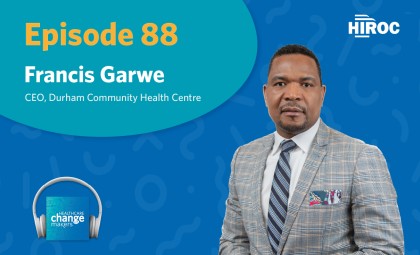
(Access show transcript) Francis Garwe, CEO of Durham Community Health Centre, shares deep insights into his leadership journey and his philosophy behind listening as a skill, building trust, and community empowerment for creating meaningful system change.
Summary
Francis opens up about how his experiences as a newcomer to Canada and a trained mediator shaped his leadership philosophy, emphasizing that listening is a foundational skill all leaders must intentionally practice.
Creating a culture of trust means creating a space for staff, partners, and community members to share their perspectives, and through this, his organization has been able to design services that truly reflect the needs of the community they serve.
From launching programs that address inequities to building a vibrant Learning Hub that fosters intergenerational knowledge exchange and ideation, Francis illustrates how empowering communities can unlock innovation and lasting change that include perspectives from all walks of life.
He also offers several great lessons for leaders:
- How the community can be considered a library of assets, and organizations should open their doors to invite those assets in
- Resist the temptation to do everything alone, as many successful programs can originate from community ideas and collaborations with partners
- How trust, integrity, and respect are non-negotiable values
Our conversation also explores how Durham Community Health Centre approaches care through a person-centered lens, addressing not only clinical needs but also social determinants of health such as food security, connection, and access to services.
Francis also highlights the importance of partnerships and a shared purpose, including collaborations with organizations like Lakeridge Health and Queen’s University, to strengthen community-based healthcare.
Mentioned in this Episode
Transcript
Imagine you could step inside the minds of Canada's healthcare leaders, glimpse their greatest fears, strongest drivers, and what makes them tick. Welcome to Healthcare Changemakers, a podcast where we talk to leaders about the joys and challenges of driving change and working with partners to create the safest healthcare system.
Marc Aiello: Hello, listeners. Welcome back to another great episode of HIROC's Healthcare Changemakers Podcast. Today, I'm joined by Philip De Souza.
Philip De Souza: Hey, Marc. How are you?
Marc: I'm good, Phillip. How are you?
Philip: Good. We got a good episode today. Our CEO, Catherine, myself, and our other colleague, Trevor, we had the pleasure of visiting Francis Garwe at his organization, Durham Community Health Centre. And we learned so much, and we were so impressed with what was happening in his community that we said he has to be on our podcast. And so, Marc set everything up. And me and Marc are delighted to bring you this episode with Francis.
Marc: That's right. And Francis has a ton of great nuggets and knowledge to share. And so, without further ado, here's Francis Garwe.
Philip: Hey, listeners. It's Philip and Marc here, and we're so lucky to have our good friend Francis with us. Hi, Francis. Welcome.
Francis Garwe: Good afternoon. How are you? And thanks for having me.
Philip: I'm good. How's your day going?
Francis: So far, so good. You know, excited about the rain. Hopefully, we can get some snow going away. Melting, hopefully.
Philip: Hopefully. Exactly. Well, you know, they say spring showers brings May flowers.
Francis: That's right. I love that. I may use that next time.
Philip: Well, our listeners would love to know a bit more about you. So, why don't you tell them who you are, where you work, and tell us a bit about the community where you work? As listeners will hear, you work at Durham Community Health Centre. So, tell us who you serve. So, tell us, first, who you are and where you work.
Francis: Okay, wonderful. My name is Francis Garwe, and I'm the CEO of Durham Community Health Centers. And as you probably would be aware and our listeners will know, Durham is one of the fastest growing region, with about 780, 82 attributed population across the region that we serve. And I spent most of my career working--at least the last 10 years working in community-based healthcare and social services system, which literally is the passion of my day-to-day waking up.
Philip: Very cool. And what personally drew you, and continues to drive and build your passion for working in community-based healthcare?
Francis: So, my passion is rooted more deeply committed to advancing equity, access, and dignity in care, especially for people who face multiple, or sometimes, often known as too many barriers. And normally, these people are left out of the mainstream planning of traditional health care system. So, to me, that becomes a significant passion that I take deeply and also have the honour to feel I'm serving the community with some of the elements and services that meet them. They are probably worse opportunity, some of them, depending on what they are looking for, but some of them at the right moment to keep them thriving.
Philip: I'm so glad you mentioned that point about people who are left out and making sure you listen to them. That's important. And so, that passion, I can--we were so lucky to have a tour. You gave us a tour, you and your team. And we love seeing everything and hearing all the impact you made. And so, I guess one more deeper question is, like, that passion to make sure that you hear the voices of those who are left out. What drove you to making sure you want to do that in life, too?
Francis: Myself, as a newcomer, I moved into Canada right around 2008. And of course, you know, having worked in other systems in US and then--but also coming into Canada, being a public health system, when I noticed the intersection of social services and healthcare, that became a true passion because the face of the community that I saw was exactly a representation of the communities that I come from as a leader coming from an ACB community and also being a member of the African diaspora at the time of moving in. That calling in serving those folks who have those barrier. And also the whole person when they enter our clinical settings or our environment, that actually was more rewarding than anything I could find. I've spent my other times in hospitals, so as a hospital administrator. So, this actually was exactly the sweet spot and continues to be a sweet spot up to today, 10 years later.
Philip: That's amazing. I also love how you mentioned that call to serve. That's a really good leadership lesson. And speaking of leadership, I know it's a leadership podcast. I know our listeners would like to know about your personal leadership journey. You gave us a little bit just now. You know, what would you say was the point in your career where you felt you were making a real difference personally for those around you? And I guess, you know, you touched a bit about it, but, like, what has motivated you along this journey, your leadership journey?
Francis: So, and I will give you a little, you know, synopsis in there of part of my past. I graduated. My first degree was information systems, and I worked for SAP for a number of years. And I'm a pharma's tech by training and also certification. So, somewhere along the line, my dad wanted me to be a lawyer. And he has been trying to convince me to get into law school, and I started that journey. In my second year, I decided law school was not for me. And I decided to switch the direction of education. And by the way, I didn't tell him right on time that I was switching. And this is where you notice the courage of trying to stay the course and keeping that whole secret to yourself.
So, it was up until my third year in there when I told him that, dad, I think my calling is into healthcare, but I'm not good in touching blood and doing all these things. But I think I can be the most of the support in the back office in creating systems using my information background to be able to design systems that work. That's when I had to take my course and my direction in the Masters of Healthcare Administration and Healthcare Management at that time. And it's a passion of mine that I noticed, yes, I actually can be delivering care in indirect, but direct ways as a systems thinker, as also an individual who could infuse some of the personal experiences and in the gaps that I've been experiencing in how services were given to me and given to other folks.
So, it didn't take too much convincing. Oh, well. To close that loop, I had to say to my dad, understand that this is what is gonna keep me excited versus the criminal law that he was pushing me for. So, he ended up getting successful though, because he convinced my young brother, who comes right after me. He's an attorney and works in a high court system as an adjudicator. So, he got his second luck in my brother, but not so much for me.
Philip: That's a good story. I love it. And I love the fact that you mentioned--I feel it's a really important leadership lesson, to have courage. And I love that you talked about, you know, the courage to stay the course, because I think that's a leadership lesson that sometimes we forget because people--we just want to, you know, get things done. And, you know, sometimes, we make knee-jerk reactions. But when you have courage, you're taking time. You're sitting with the problem. You're finding solutions. And I'm so grateful that you said that, Francis.
Francis: Oh, yes. 100%, you know. Here is the part to that as well. You know, part of taking that courage, especially being able to say, this is a family wish, but I'm going against that and I'm gonna pursue something different. Remember, with some of these career opportunities, there is where passion leads you and there's where economics lead you. Those two pathways actually yields two completely different directions. And one of them actually, you know, wakes you up every morning wanting to do more and do better. And definitely, the passion that I chose for me, this was exactly the reason why even today, I turn around that I'm looking back 20, 30 years later, I can still do this job. Had it not been for my mortgage, I'll do this for free, but I have to pay bills for my sons. I have three boys. So, I have to do this to make sure that I can put food on the table for them.
Philip: Exactly. And have you told any of your boys that they have to become a lawyer?
Francis: I haven't gone there. The fun part of the story is my dad had to break also the news to them to say, hopefully, you're not going to be like your dad, who told me two and a half years later that he has changed the course without telling me.
Philip: Too funny. I'm gonna pass the next question off to my co-host, Marc. Marc.
Marc: Yes. Hi, Francis. I've really been looking forward to speaking with you. So, you know, you once described your professional philosophy as being rooted in facilitation, negotiation, and mediation. I was wondering, you know, how did that philosophy take shape over the course of your career so far and how does this show up in your leadership today?
Francis: Thank you for that. I'll take you back to my studying law as that lawyer who ran away from the profession. Instead of losing those credits that I paid tuition for. So, what I decided to do was convert some of those hours into being trained and certified as a court mediator licensed in Texas. And it's a profession there that is very much booming. So, you deal with all arbitrations that are going between, you know, the judge and yourself, depending on the cases that you are working with.
So, it has opened an opportunity of a little bit of the legalese element that I was running away from. But what was different in the mediation program and the work that I had to do in getting certified was that the ability to be able to be an intentional, deliberate listener is critical. Because in those proceedings, your job is to make sure you attentively listen and collect facts the way they are being presented. And then you have to present those same facts to the judge who is going to be helping and presiding some of those cases, depending on the magnitude of the case.
So, the ability to even use that skill set today in my day-to-day work, number one job of a leader in any institution is to be able to be an anchor to your most important resources, which is my staff. Being able to be that--using that mediation skill set in listening to some of the gaps, the challenges, the opportunities, the areas that they want to bridge into is a skill set that helps with that. Part of the mediation, there's a full module on facilitating conversation. And that element is evident in the direction that I do today in my work in terms of, how do I guide the vision that my organization is taking? But how do I also pull those around me to see that vision? Remember, part of building a vision is telling a story in ways that people understand how to join you on that journey of building that. So, the opportunity to have that opportunity to facilitate using that skill set has been incredibly rewarding.
In my previous hospital job, before I got to this role, I was in B.C., and I happened to have the privilege of leading OD, part of the work in organizational development. And the larger part of my portfolio was mediating physicians, complaints, and physician staff, etc. So, the ability to be able to hold the space and create the space for the individuals that are coming into those mediated conversations within an employment relation was crucial based on the skill sets that I had actually amassed during the period of--maybe this is where my dad would say, well, you didn't do very bad, anyway. You took those skills that I wanted you to have and you are using them to develop this other side of your other mental capabilities, to lead others and lead the visions of your passion. Maybe he will say that one day. I'm waiting for it.
Marc: That's excellent. And I'm so glad that you pointed to listening in particular as a skill. And just to kind of maybe follow up on that. Do you feel that--you know, for leaders that are listening, do you feel that listening is, you know, something that you can develop over time as a leader? Or is it something that more that, you know, you need to bring to the role, you know, out of the gate?
Francis: You know, let me start by saying it is a muscle that you have to exercise like you are using your biceps every day. And one of the elements as a young leader, when I was growing up in this profession, I recall having the temptation to be an expert in the discussions or in the guidance of the conversations that I would ever lead. Quickly did I learn that the power of listening is more effective than the ability to open my mouth and speak. There is something that you will probably relate to, which is the element of competence compulsion, in which one wants to quickly demonstrate their competence in demonstrating a framework, a theory to justify the direction of decision making. That is, I want to call that, a trap that as leaders, we must stay away from.
Remember, in healthcare, we hire already highly competent, skilled, specialized individuals. They already come in to us with expertise that they are here to perform that which they are passionate to do, because they trained as physicians, as pharmacies, as OTs. So, creating the space for them to do that work does not require me, as a leader, to be able to speak and guide, but to hold the space and be quiet and listen attentively. It is a learned skill. I'm doing it today as I'm sitting in my meetings to kind of wait and have others express their opinion and just take it up.
Marc: That's excellent. Thank you, Francis. Back to you, Philip.
Philip: Yeah, I was just--I love that the fact that--I like that you mentioned about that flexing, exercising like a muscle, and that whole point about listening. And actually, Marc was telling me about, you know, something that someone--that you had referenced. I'll let Marc ask the question, but I thought it was very important 'cause I'm a huge fan of, you know, culture and keeping your teams connected. And so, Marc, I'll let you actually ask that 'cause, you know, we were talking about it before about what you saw on LinkedIn.
Marc: Yeah, absolutely. And this ties in, Francis. So, on LinkedIn, you know, I was taking a look at, you know, what you've been posting. We follow you. And you once, you know, referenced Dr. Peter Drucker's idea that culture eats strategy for breakfast. And I want to ask, you know, what does that saying, you know, mean to you and what does investing in people look like for the centre, of course?
Francis: 100%. He's one of my favourite author out there because the elements, especially on culture eats strategy for breakfast is real in the spaces that we are in. So, to give you a quick example, coming out of a hospital system where systems are built, structures exist, and tools are already prevalent in the system where you can do your work, shifting and coming into community-based care, you are actually now in a different space. I normally call that now you are cooking with a gas stove from electric stove. Very different energy methods. The community is very--I want to say, maybe the term I can use, very sensitive. When you are delivering a service into the community that is not informed by those whom you are serving.
Hospital departments are created differently depending on the specialization. You go to diagnostic, you go to OB, to ambulatory. All those elements are in play for the diagnosis that needs to be addressed. But when you're in the community building and developing these services, listening and being able to be connected to the culture of a community. And some of the segments of those communities might be same groupings of population. But by the time you go from person one to person two, their needs are different. So, what that means for me, when culture eats strategy for breakfast, was the ability to be able to say, hold on a second. I might need to unlearn to relearn, so that I'm able to appreciate where these services that we are developing are going to land and which voices are missing in that. So, that also means engaging our teams. My teams, we are working on day-to-day in the front lines, how to make sure that the culture of listening and the culture of design or co-designing with those who receive your service, crucial.
So, notice that by doing that, we are actually creating a culture that we are perpetuating in a very positive way. That allows the community, not only are they buying in, but they are owning the design and the implementation, including the access to those services. The culture of trust and the ability to be able to give space for those that are accessing those services and how it's designed. Very powerful aspect. So, when you hear Dr. Drucker talk about culture eats strategy for breakfast, he's actually referring to some of those simple but powerful areas of appreciating that what might have worked for you, Francis, on this other side of the table is not necessarily directly transferable to the current culture of the organization and the systems that I had to work with. So, that ability to learn and unlearn and relearn was actually a very crucial piece.
Marc: Yeah, that's fantastic. And I think that does really well to, you know, segue into, you know, I guess the second part of this question. You know, we've talked, of course, a lot about listening and the importance of having that open dialogue, you know, whether it will be with your staff, with the community, or with your partners. I was wondering maybe you could tell listeners just how, you know, those crucial kind of conversations, how they look like in practice at your organization.
Francis: Indeed. You know, so let me give you an example of one of the areas that we recently, as in two years ago, maybe about two and a half now, we have had to embark on. Durham region, as you know, again, I mentioned earlier on, fast growing region. But one of the elements we noticed during COVID was the inequities in terms of how the services were being delivered across the region. And Durham has actually pretty much, we might call it a mini United nations because you can find all population segments in here, African diaspora, Caribbean, South Asian, East European, and you also find indigenous folks. So, it is a significant area in which culture is rich.
So, during that time, we noticed during the testing most of the challenges that we're seeing, people from the ACB communities were not fully showing up to some of those screens and the testing that were happening, including leading up to vaccinations. So, as a very curious person, I decided to have some discussions with our team to find out what exactly are some of the elements that we are missing here. Because on hospitalization, we were seeing some other numbers going up in the ACB community, and without understanding what's going on. So, we decided to have some real discussions with the community leaders to appreciate where we needed to go and how we needed to access support for those communities. And again, this is where you see the power of listening to your staff members because they spend time in the community, they spend time in the clinics to appreciate where the gaps that they were seeing.
So, we were able to sit down and hear some voices that were missing. And the interesting part, even the idea of us engaging a third-party organizational researcher to come in and spend time on the ground in Durham region, doing assessments from every corner of Durham region, where we ended up appreciating that. And on fact, Durham region ends up being now up to today, the only region with the largest black people per capita in Canada, which is information we found out during that time of listening and being able to engage partners who are serving ACB communities in different ways. You know, one of the areas that we find out a lot of those information from grocery store, convenience shops where people were shopping and visiting. Very untraditional ways of identifying trends and patterns of where people were coming from.
So, in that, we ended up actually developing one of the powerful program, which is Black Health and Wellness, which is serving most of those ACB communities in our region. But when you look at what has led to that, the ability to be able to have partnerships that can trust those relationship in leading to the outcome that ended up developing assets, maps, and tools that helps us to be able to say, yes, we got the message. And when we did that, we took that document that came from research and we push it back to the community and say, can you read it back? And let's meet at the Convention Centre to hear whether we captured what you told us. And the community packed the whole space there and they were telling us exactly some feedback that we incorporated back. And then just about a year and a half ago, we launched that program. And now, we are serving clinically in terms of attaching to primary care, you know, education and health teaching, even addressing things like sickle cell in partnerships with our good partners at the Lakeridge Hospital where we actually have those clinical pathways that lead people in and out of the hospital, well-connected services.
So, it is a moment of pride when you see the power of engaging and the power of partnership, as well as the power of listening. And, again, I'll say intentional listening. Not listening because we are the solution, but wanting to know that which we didn't know so that we can know what we don't know.
Marc: Yeah, that's excellent. And, you know, as a follow up to that, you know, I was, you know, researching and reading. I saw an article by Durham College that had come out talking about, you know, a recent seminar or a recent event called Building Tomorrow: Black Entrepreneurs and Leaders Pushing for Change that you had spoken at actually earlier in February. And I wanted to ask you, you know, what did that mean to you to be able to, you know, speak at an event like this and you know, have this opportunity to speak more about, you know, the philosophy that you have and, you know, have going on at Durham CHC to this group?
Francis: Indeed. Building generations for generations to come. Very powerful direction that the centre and our partners that came together wanted to make sure that not only are we imparting knowledge to the next generation of young leaders, but also to anyone who aspire in the community to come up with innovative ideas and be able to help and serve and support someone. So, that part of the conversation, what it means to me, you know, think of this as a relay. When you are in a four-way relay race, you have to think about, how do I make sure that as much as I'm running my leg, how do I make my next relay partner be successful in that last leg that they have to run? So, you have to have a strategy on, how do I hand the baton and which speed do I need to get to them so that they don't drop the baton? So, when you see this building generation, it's part of the idea of thinking if we want to sustain one generation after the other within the community, there's multiple pieces I needed to consider there, not only representing the centre, but also as a leader, to say who do we need to make sure we invite?
I think you notice Durham College when they put it up, we invited young grad students and also community members who were also mentors to be in this space so that when they see leaders in our position, it is not something that happens overnight. But there's also an investment that happens by some who are ahead of us to make sure that the next generation can have a better stepping stool to be able to jump from or to reach from. And this is exactly one of the areas that I take pride in. There's one good author that I like a lot. I read his book. He's an economist. I'm not an economist. His name is John K. There's a book there that he wrote. It's called Obliquity. And what he is referring even in that book, when you have time to read it, is called, how we meet our goals or achieve our goals through an indirect way. So, part of the indirect way in that strategy that we had in terms of the conversation of building generations to come was to make sure that it's not about where we are today, but it's where we were coming from that led us to where we are now and where we should be tomorrow. So, imparting that knowledge was crucial.
Philip: Very cool.
Marc: Yeah, thank you. Yeah. And we'll make sure to also make a note of that John K's book for our listeners. And to switch gears a bit, Francis, you know that you've mentioned how Durham CHC takes a whole person approach to care. I wanted to ask, what does the whole person approach to care? What does that mean beyond clinical services? And how do your programs bring your community together?
Francis: Indeed. One of the framework that we created here over a couple of years, maybe three years ago now, in trying to make sure that we are person-centred in the care that we give was to look at the whole person from, not the disease aspect, but the lifestyle and the engagement of people within communities. You know, if I can reflect you back even during COVID when everything got shut down on that March day in 2020, one of the unpopular decision that I made at that time and went to convince my board--and even at that time, it was very challenging for the board to really stand with me at that time, which they later on did, which I appreciated. We made a very intentional decision of not shutting our doors, not even for a day. We kept our doors open throughout COVID when everybody else was gone. There was nothing downtown from Tim Hortons, including the hospitals had closed their doors. You only had to go there for an appointment or if you were being brought there with an ambulance for emergency, you know, procedure or something. That would have happened, but our doors were open.
The reason for thinking about the whole person, we looked at this and said, there is a number of community members who depended on us on any given day that was non-COVID. So, with COVID, that would have meant not only the desert areas that did not have services, but it would have meant the basic social supports of those community members were actually going to disappear. You know, we run food security here. We also sometimes run groups that are specifically, say, women's group, men's group, indigenous tea evenings, and/or groups that are for counselling services. So, we knew by removing these services, it would have meant this community was actually gonna be in a much, much more disastrous situation. Including things that we took over there was, you know, all the breakfast programs that schools used to run on a normal time. Those were gone. So, we decided to open that and bring the communities here to access those services through us agreeing to partner with the school board to make sure that they would transfer those budgets from Durham District School Board to give us those resources so we could continue to serve. And we had lines that were stretching almost for, I want to say a kilometre and a half from the front door, people coming in to access those service.
So, now, when you think about the whole service, most of the people who would actually just look at us from an HSP, which is the health service provider, they would think, you know, this is where we get our primary care to go see a doctor. But what's going on here is the food security, is the social gathering in which we actually continue to have people interact safely, but also giving support that they needed to continue to live in the home at that time. We signed one of the most important agreement with Telus from their head office in Vancouver, where we noticed those people that were unsheltered, they had no way of either accessing care or reaching out their loved ones because everything was shut down. They used to have those services in library. So, Telus agreed to sign an agreement with us to give us almost 45 smartphones that were all, you know, with data as well as voice and text, which we ended up actually identifying members of the community with chronic diseases who were living on the street, issuing those phones, for the duration of the first year of COVID so that they can get some support.
So, for us, when we looked at that, it was not the disease. It was, what does the real person want on a day-to-day to be able to sustain themselves? And how do we make sure that those needs are not one-size-fits-all? Somebody wants a phone, but somebody wants food. Somebody also wants their medication support. Somebody wants mental health stabilization. And that's when we developed even the virtual care that we run today. So, that element, Marc, of understanding that the community comes in different shapes. But when we look at the person, we need to look from top to bottom. Total appreciation of them as a human being with different needs is crucial to this part.
Marc: Yeah, and that's superb. Recognizing and recognizing that, and then being that pillar of the community so that the community understands that your organization is, you know--if they need help in whatever way, that it's more than just, you know, a clinical program. It's a pillar of the community where they could receive that support. And I know that, you know, you mentioned a bit before in our conversation, you know, that partnerships, they're central to your model of care. You even talked about, you know, a partnership that you had with the community, especially during COVID, to get people the support that they needed. I was hoping maybe you can elaborate more a bit on that. You know, how do collaborations with organizations--you had mentioned Lakeridge Health, and of course, you also partnered with Queen's University. How do these collaborations really strengthen your approach? And in your opinion, you know, what makes a partnership truly effective? What's that special sauce that keeps things moving forward?
Francis: Thank you for that. You know, the area where I start in any partnership and relationship we build, it needs to start with areas of common interest. And, you know, fortunate enough, every partnership we have, it's starting from the person-centred, people that are coming to us or people that otherwise should be coming to us that don't know how to come to us. And then from there, we almost start to build from inside coming out. You know, if you think about the onion and the onion rings, that's exactly how we come to say what is at the core today of these people that are coming to us and the service that we want to give. So, in our partnership, we intentionally identify those partnerships based on the opportunity or it could be a potential challenge that would want to address.
You mentioned Lakeridge, Queen's University. The partnership that's there is mutual partnership that is also geared to a systems thinking approach. Because as you know, Lakeridge and Queen's, they establish one of a kind medical program in the country in which those cohorts of students, the medical learners, they are on call three now, that come to start medicine, they are focusing precisely on primary care. But, however, in that model of primary care is looking at, how do we, as a community health centre, being able to enhance the learner's experience from a profile of the community that they are going to be serving? Most of these medical learners knock on the hood as they graduate. The hope is they will stay in the region in which they can be part and parcel of the provider network that will understand how the system work, what does a framework in a CHC look like in a family health team, in a family health group, nurse practitioner-led clinics, acute centre, how do they move and navigate their patients in there.
So, in our partnership, we thought, here is an opportunity in partnering with these new learners that we can actually begin to synthesize their learning and understanding the community assets that will actually make their careers enjoyable, knowing that they are not actually going to be going at this alone. Because when you go into a solo practice, you notice most of those physicians, not only are the providers, not only are they dealing with with a heavy caseload of patients that are complex, but then they have also to play a navigator role of figuring out, where can I send this person and what services are there and how can I know that they are getting the right service at the right time for the right need?
So, for us being able to build that in that partnership when we are teaching learners here to say, hey, this is what we can do. And fortunate enough, even with that relationship, we have developed an elective that is actually starting this spring in which these medical learners are going to take that elective that was developed by this centre, infused into their curriculum towards their graduation so they understand, what does integrated care look like from a community health approach, in which it is there to address the quadruple aim in the process of them enjoying their work here? So, that part of partnership, Marc, I would say each time we go to it, it's not just about what DCHC, or Durham Community Health Centre is looking for, but it's centered on those that are coming to us for service and also the strength that are coming from the partner themselves in that relationship, so that it's a truly triad relationship. Triad in the sense that here's a partner, here's a patient, here's DCHC. All these assets are there to actually not only improve the well being, but also maybe easy the access within a complex system.
Philip: Yeah, I love that point about all the parties coming together and how each party has their own strength. I love that you mentioned that, too, Francis. And when we came to visit you, you and your team told us all about creating a learning hub that supports education and guidance in the community, while, of course, stressing social determinants of health. And so, we at HIROC really value it's the cornerstone of our model is sharing knowledge. So, we love that this learning hub is something that you and the team created. And so, what inspired this approach?
Francis: Community capacity building. And when you walk around the aisles in our organization, you hear my team talks about that. How do we empower the community? How do we build capacity in the community? You know, so that when we do it right, that individual becomes a magnet of support to the next person and continuously that way. So, in the learning hub, you know, I mentioned even the partnership with Queen's. When the students come in here, they meet with our medical leaders in here, they learn in there. But also what you see in that same learning hub is we have, you know, what we call generational knowledge transfer. We have seniors that come in to do knitting, crochet, and repairing ripped pants, etc. And you also have group of youth from high schools that will come in there and also share the digital technical know-how with those seniors.
So, there's an intergenerational information exchange, but skill, that are being exchanged across these two different segments of population, and which actually happens to really bring the old traditional ways that knowledge used to be passed between those with the wisdom to share that from the passed on knowledge on how to sharpen the scissors. I never knew that there could be a program like that. But here, they have started that program here. And you notice in that group, and this is where it actually just gives me the vibes of wanting to wake up every day to come. You have even those seniors, when they come to do crochet, one will bring a pattern on a paper, one brings in crochets or the different colours, and one also brings say tea that can be shared in there, like chai tea. And this is beautiful when you see these people come together and do this. It's almost like, wow, what have we done here, without knowing exactly how this was going to end? It actually has become almost like a hub where things get created. And you notice that even during that time when folks are speaking in there to say, oh, I wish I can do this. The next thing that you see in the next quarter, those programs are created.
An example. We had newcomers that were coming in there teaching others how to teach and how to sow and replace missing zippers on a jacket for kids when they come to our after school program. And it actually turned quickly into training for English as a second language, because Durham College identified that we have a lot of newcomers that we serve, but they need English as a professional language to be able to secure employment. And Durham region and us ended up partnering. And if you come every Monday and Wednesday evening from 5 to 8, you notice that there's a cohort of 16 folks that are in there that are learning, and it started from there. And there's multiple things that are going in that lab that also include our indigenous population. They teach and sew, you know, ribbon skates, moccasin shoes, using real deer hide that they prepare, cut, and stitch. So, that knowledge within that learning hub is actually powerful. So, the learning hub becomes a hub now that exactly, you know, brings these mouth generations and information sharing, knowledge sharing. But also not only just that, designing functional pieces that can be used in the home by different community members.
Philip: No, I love it. And I love the fact when I was listening to you, I hear the words, everyone that comes to your place is like a piece of the puzzle. And no matter what age they are, no what background they are, and they each have a role to play. And you and your team are sort of like the facilitators to bringing the puzzle together and letting everyone learn from each other. So, I love that. When I hear you talk, that's what I hear. And so, which is really amazing. It's truly a special place. And so, you and your team have done so much, Francis, at your place. What's one piece of advice--so a lot of leaders are listening right now, a lot of board members. What's one thing, one piece of advice you would give them to, if they haven't started their journey yet and they're not at the place where you are, doing all the things you're doing? What's one thing that's helped you along the way? What's one piece of advice you'd give them to get their journey started so they can scale what you've done in their community?
Francis: I love that question, but it's a dangerous question for me because I never feel like I have a solid advice. But here's one thing that comes to mind right away, Philip, is the community is a library of assets. Learn to open your doors for those community members to come and pour in into that cup. It is a powerful piece that you will notice once you do that, you continuously become almost like a hub of innovation every time when that happens. But also to young leaders who might be listening and/or to all of the leaders who are out here listening to this, resist the temptation to do it all. All the pieces that we have done right now, whether it's program creation, it's an opportunity to engage, it's an idea that was not forwarded by a very smart specialist or an engineer. It's actually the community that says, only if you can have this.
An example, Philip, when you were here, you saw our outdoor wellness centre which was covered with snow, one of a kind in Canada. And that idea was borrowed from Ohio, Cleveland, generated by a cardiologist over 26 and a half years ago who noticed a number of patients coming to his practice where he ended up having to recommend some amputation, and it was not attainable. Then he decided to have one small intervention based on community feedback, to take those patients who were on that borderline of losing their extremities, to go walk with them within a park close to the clinic. And it actually turned the results of those patients, most of them, reversing some of the risks that they were facing to lose their extremities.
So, Durham Community Health Centre, when we saw this, and we know we are also serving people with multi or comorbidities, we decided, you know, what can we do by actually asking folks if there was something that would make you want to be here from anytime you want so that you don't stay in the house? It's actually some of the seniors that said, if I can have an opportunity to come walk, have tea, and walk with somebody, but also understanding that what I'm doing is going to contribute to my well being. And then put a place there where my grandkids and I, we can do things together. That's why you see that outdoor facility, you can walk, you can play ping pong, you can also play soccer, you can do volleyball, you can do basketball. All those things are done in one small area.
By the way, even our Minister of Health, Sylvia Jones, you know, when we opened it, and also Minister Parsa from MCCSS, they both actually were very supportive in having something like that in Ontario as the first, but an opportunity to intervene in medicine in a different way. Remember, 70% of things that impact us health wise is not so much that clinical diagnosis. These are the social determinants that we fail to address at the point where we have the opportunity to.
Philip: No, I love that you mentioned that. And the social determinants of health are so key because I remember that I was at an event and they were talking about how one hospital--this wasn't here. I think it was an event I went to where there was, like, a group from the US. And this hospital was trialing something where they left bikes around their catchment area so that people can come to appointments at the hospital because they realize that some people don't have transportation to get to the hospital or to get to their community centre. And so, this was a way, a mechanism, for those who were able to do so to get to their appointments. And the community was really grateful that the organization invested money in these kinds of modes of transportation so that people can get the care they need. And it became a true hub. And I feel that that's what you've created at your place, a true hub for the community to come and to get care, but to also get care in a variety of ways. And that may be through the learning hub. That might be through all the things you mentioned outside with the garden. And so, I think--and of course, you have other things, too, 'cause there's so many things. You have virtual care and you have the partnerships and the places that people can come to do many things at your hub that they may not have to go to different places for different appointments. And so, when I came, I was very impressed and I was blown away, actually, Francis, with what you're doing.
Francis: Oh, thank you. Thank you. It is our hope that each time when we are listening, the opportunity to be able to bring some of those ideas to life becomes actually a passion of ours. And our teams are well invested in that. And Marc earlier on asked the question in terms of what is it that makes this work important. Actually, for me, what I enjoy a lot is when I find myself creating spaces for our most important assets, which is our human resource, because we are a human capital industry, end to end. The person giving care and the person receiving care, in between the processes and assets we use. But making sure that I equip our teams and being able to create a space where they feel that the space is in between is all about creativity to make sure that the other person walks away with an experience and an outcome best possible for them is actually a motivation for me.
Philip: No, absolutely. And I have one last question before I pass it back to Marc for the lightning round. But I'm only going to ask you this 'cause you talked about your family, your immediate family and growing up and all the stuff your dad told you. I can hear in your voice that you have a deep sense of rooting of values in family values. And you know, I can tell how much family means to you. And so, was there someone--and it could be. Is there someone in your family who continues to provide you with that energy and drive and motivation to keep being you and being so, you know--'cause you're a very unique and special leader, Francis. And I can hear it in your voice, I can see it in how you interact with your team, and, of course, your community. But where did that come from? Was it a parent, a grandparent, your kids, a spouse, a cousin, a family member? Where did you get that from, that drive?
Francis: My late grandfather, who was a source of wisdom. Funny enough, he used to, you know, throw these jokes at me because even though I'm 5'11", almost, you know, short 6 foot, I always say that I was. I'm still the shortest among the boys in my family because Everybody's at least 6 foot and 10. And so, he used to say, you know, the reason you are shorter than me, it's so that I can pour the energy down. So, continue to make sure that you listen up. So, you know, even though it was much more in a joke and sarcastic way, I truly believe, I think that as a pillar for him, being able to inspire me in many different ways has actually continued to ground me in some of the important values that I carry today.
Philip: Oh, that's a lovely story. Thank you for sharing that. And I'm gonna pass it over to Marc for your lightning round questions. These are just--your answers, they could be one word or a few sentences. But I'll let Marc take it over.
Calling all art lovers and appreciators. We can all agree that art is central to understanding human experience and can provide valuable insights into innovation, leadership, and strategy. HIROC's new strategic plan, the Art of Safety, pulls from both the art and healthcare worlds. It leans into the idea that each person in the Canadian healthcare system has unique skills and talents that are valued. Most importantly, each is a gifted professional, or better yet, a unique artist who is there for their community. Learn more about the Art of Safety by heading over to hiroc.com or by clicking the link under mentioned in this episode. Enjoy the episode.
Marc: Yes, thanks, Philip. And absolutely. Yeah. Since we're nearing the end of our time here, the lightning round is just kind of a rapid fire question period. And so, for my first one, you know, we read that you were actually a torchbearer for the 2010 Olympics. I want to ask, you know, what did that experience mean to you?
Francis: Was a privilege. Felt honoured to represent the country that I call home, I love most, Canada. So, that is historic. And I still have that--I have the original torch made by Bombardier that's in my house today.
Marc: Oh, that's awesome.
Philip: Very cool. You have to send us a picture, Francis, so we can include it, so our listeners can see the picture, too, if you can.
Francis: Oh, 100% I will. And including the engineer who created it. They have their name there.
Marc: Oh, that's awesome. That's so cool. And my second question is, if you weren't in healthcare, I know we talked about a bit of that at the start. But what job would you be doing if you weren't in healthcare?
Francis: I'll be a farmer. Again, from my grandfather. Love to grow things and see things grow.
Marc: That's excellent. We talked a bit about, you know, the leadership advice that you would give. But you personally, what was the best piece of leadership advice that you've ever received?
Francis: In my early years being trained, when I was in Special Forces, I was told silence is the most powerful energy you can invest in yourself. Silence, very important. Powerful. And listening.
Philip: Yeah. At the pause. Very important.
Marc: Yeah, wonderful. And this will be my last one. What's a value of yours that you absolutely won't ever compromise on?
Francis: Trustworthy. I think they say trustworthy is not a value, but trust is for me, because everything anchors on that. Whether it's integrity, whether it's respect. One has to trust you to be able to give you that. So, that to me, my word is my contract. I believe in that.
Marc: Excellent. And that's all for the lightning round questions.
Philip: Thank you so much, Francis, for joining us today. We really appreciate you taking time. I know, I took lots of notes, and I know our listeners will truly appreciate all the wisdom you shared. And I hope, listeners, you scale some of Francis's amazing things at your organizations and continue to build your communities like Francis has built his.
Francis: Wonderful. Thank you, folks. I appreciate your time back.
Marc: Yeah, thank you, Francis.
Thank you for listening. You can hear more episodes of Healthcare Changemakers on our website, hiroc.com, and on your favourite podcasting apps. If you like what you hear, please rate us or post a review. Healthcare Changemakers is recorded by HIROC's Communications and Marketing team and produced by Podfly Productions. Follow us on Twitter @HIROC Group, or email us at [email protected]. We'd love to hear from you.