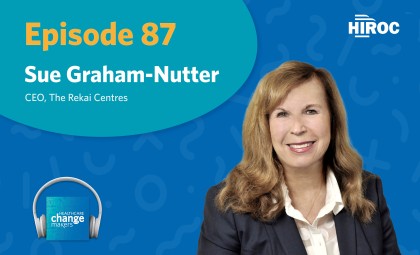
(Access show transcript) Sue Graham-Nutter leans into her curiosity and gathers a full perspective on the world. She carries her learnings into her role as CEO of The Rekai Centres and finds new and informed ways to support the long-term care sector.
Summary
Sue Graham-Nutter, CEO of The Rekai Centres, and her entire team are hard at work developing a new long-term care home in downtown Toronto, the Cherry Place Campus of Care. The heart of this new Campus is innovation, and the collective input from the community and their partners.
While leading this major construction project, Sue reaffirmed the value of relationships with organizations such as HIROC, the Ministry of Long-Term Care, the City of Toronto, and many others.
We hear about The Rekai Centres’ Rainbow Wing and how it’s addressing the need for community for 2SLGBTQI+ seniors.
Sue also weaves in stories of her family and friends and reminds us to listen to our inner Little Engine That Could – to believe in ourselves when things get tough.
Mentioned in this Episode
Transcript
Imagine you could step inside the minds of Canada's healthcare leaders, glimpse their greatest fears, strongest drivers, and what makes them tick. Welcome to Healthcare Changemakers, a podcast where we talk to leaders about the joys and challenges of driving change and working with partners to create the safest healthcare system.
Michelle Holden: Hey, everyone. Thanks for tuning in for another episode of HIROC's Healthcare Changemakers. I'm here with Abi. Hey, Abi.
Abi Sivakumar: Hi, Michelle.
Michelle: So, on this episode, Abi and I sit down with Sue Graham-Nutter, CEO of the Rekai Centres in downtown Toronto. Abi, what are some things our listeners will hear today?
Abi: We talk about the story of the Rekai Centres and who they serve, and the new Cherry Place campus of care being built as we speak. Sue also shares the value of family in her career journey and how they're tied to the important work she's doing.
Michelle: Right. We were also excited to learn later in the episode that Sue is a bit of a swifty. So, listen for that one. And now, onto the episode. We hope you enjoy. So, hi, Sue. Thanks for joining us on the podcast.
Sue Graham-Nutter: Oh, thanks so much for having me. I'm looking forward to it.
Michelle: We are too. First, I want you to take us back though, before we kind of talk about you and your job now. Take us back to your first day at the Rekai Centres and maybe something you remember about. It could be anything.
Sue: My first day was October 8, 2008, and it was my first time in a long-term care home, to be honest, at that point. And it was supposed to be a year contract, and it's been a long year. But I remember just being amazed at the care in the residents and the interaction between staff and the residents. At that point, my parents were aging. So, I was very aware of the importance of interaction with residents in a long-term care home.
Michelle: Yeah. For our listeners outside of the GTA and Ontario, we do have some--can you share the story of the Rekai Centres and who you serve?
Sue: Sure. The Rekai Centres is located in downtown Toronto. We actually have two homes, one at Wellesley and Sherbourne and one at Sherbourne and Carlton. And the Rekai Centres was started by Dr. Paul Rekai, who was originally from Hungary. And it was the first multicultural, multilingual long-term care home. And that's very important in terms of our history and the mantra.
And then back in 1988 was the best care in any language. And his son, Peter Rekai, has been chair of the board for over 20 years.
Michelle: Wow!
Sue: And it really picks up on the stewardship that his father laid back in 1988 when the first Rekai Centre was opened.
Michelle: Yeah, that is a very long history. And it's so great to see that they're still involved, and there is that kind of history that is kind of being thread throughout even today. I was wondering what actually intrigued you to bring you--you said your parents were aging. I'm sure that was kind of going on in your life. But what really brought you to the Rekai Centres?
Sue: Actually, Peter Rekai reached out. I knew him sort of, not well. But he reached out to talk to me about a one-year contract providing government relations and--well, public relations skills to the Rekai Centres. And he knew my parents were aging and I was playing a fairly significant role at that point with my folks. So, he said, you know, the fact that I had that understanding from a daughter's perspective was very helpful. And he said the technical stuff, you can learn. It's the empathy and the understanding of what the needs were of residents, that was most important.
Michelle: That's so true. Do you bring that--do you say that to some of your teammates now? Do you kind of pass that sort of lesson along?
Sue: I'm very open about the role, you know, that I look at everything from the lens of a daughter.
Michelle: Yeah.
Sue: I don't come from the sector. I'm not a nurse. I'm not a clinician. But I am a daughter who played a fairly significant role in my folks life for the last six, seven years of their lives. And I think it's really important that we always remember that we should be resident-centred. But it shouldn't be just a phrase. It has to be part of you. It has to be what you believe in.
Michelle: Yeah, I think that's true. And it's really great that you're kind of carrying that forward as well. Since you're speaking a little bit about your past and what brought you to the public relations side, I was wondering 'cause we took a peek at your LinkedIn profile and we learned that in addition to U of T, you have a Harvard certificate in real estate investment and some other pieces. So, I was just wanting to know about this career arc that you have and how it sounds very unique just looking at it.
Sue: That's actually my LinkedIn profile. I don't go on LinkedIn. People tell me I should. So, maybe I should work on that piece. But actually, it's interesting. I graduated in public administration from U of T, and I was on the students council and very active when I was at U of T as an undergrad.
And we actually--a group of us on Students' Council called ourselves Briefcase Radicals. And we lobbied the government and the U of T administration to build a library at the U of T Scarborough campus. And I remember sitting in a minister's office at the age of 17 in the one gray suit that I owned, lobbying for a million dollars from the government. And she stood up, walked around her office and said, I will negotiate with this team here because you're being very respectful and you've asked for my time. And what exactly do you need? What's your ask? And there was no program to provide capital funding for a library at that point.
But we presented our case, and the library was opened, I think, six or seven years after I graduated. But as a Briefcase Radical, quote, unquote, we understood the importance of sitting down with ministerial staff, with the civil servants, and working a path or developing a path to achieve the goal we wanted. And that has stayed with me all my life. Just because there isn't an existing program doesn't mean if you put together a proper business plan, then you can achieve your goal. But there has to be a business plan with everybody's goals realized.
Michelle: I feel like a Briefcase Radical is your new LinkedIn headline. I think we've just updated it for you, because I like that one. It is inspiring and it's really great to hear kind of how things that, you know--just this piece around wanting to lobby to the new library sort of shaped your career in a way that you may not have understood at the moment. So, I think that's really great to share.
Our CEO, Catherine, she always tells the team to lean into our curiosity. It's something that we talk about a lot with her, and to be always learning. So, we wanted to ask you, kind of, what does leaning into curiosity mean? And is there something that you've learned in life? Maybe it's at work or in general. It's really gotten you to sit back and awe and made you sort of a better person in a way.
Sue: I agree with Catherine's perspective. One should always lean into one's curiosity. And it doesn't have to be that there's only one focus of curiosity. I love to learn and I've studied at, as you've noted, U of T. I studied at Harvard, by the way. The Harvard yard is totally awesome. And I studied what is now TMU. I did my fundraising at Humber. So, I've studied at different institutions in the formal way.
But I think it's also important that people keep on top of the news. And not just one news source, multiple sources, so one has a full perspective of what's going on in the world around them, and the opportunities for making a difference in society. So, right now, I'm paying a lot of attention on the AI, the high tech, et cetera, so that we can work more efficiently in healthcare and allow more bedside time with the residents as opposed to doing work that perhaps can be addressed through AI. But I think the curiosity is key. And it's not only just work-related. It's just being aware of the world around you. I think that's important.
Michelle: Yeah, I think so too. How do you find the time to kind of tap into all of this, the different news sources, the learnings, the AI, resources you're kind of taking in? Where does it fall into your day-to-day?
Sue: Partially because the commute time is so difficult in Toronto now. So, I have an hour each way, even though I live in the city. So, I listen to the various news stations as I'm driving and, you know, read websites, et cetera, have received invitations to various lectures. And sometimes, the speaker is interesting, you know, I'll attend just because it's interesting. It has nothing to do with healthcare. I was at a briefing that the members of the US Government gave in Canada recently on defence. Has nothing to do with my job. I was just interested.
Michelle: Yeah. You never know, though, what you'll take back, right, and the kind of perspective it gives you. That's great. Abi, I want to pass it to you. I know you have some questions for Sue to kind of continue our conversation, learn more about the Rekai Centres.
Abi: Yeah. Hi, Sue. It's wonderful to meet you. And hearing you speak about the Rekai Centres with Michelle made me think about how we love seeing in 2022 Rekai Centre open up a 25-bed wing at its home in Wellesley Central Place, known as the Rainbow Wing. Can you tell us about the space and how, since opening, it has addressed the need for community for LGBTQ seniors?
Sue: Sure. We're very proud of this initiative. It came about quite organically. One of our residents back in 2020, 2021, indicated that he didn't want to go back into the closet now that he was in long-term care, and, you know, what could we do so that he didn't feel he had to. That was quite powerful hearing him speak that way, not wanting to return to a closet that he'd left some time ago. Our background is multiculturalism. So, diversity, inclusive of the needs of the 2SLGBT community, is a part of who we are.
So, that was an easy transition for us to multiculturalism, to diversity. Hearing the residents speak about not wishing to go back in the closet. On a personal level, my cousin had passed away from HIV/AIDS back in the '80s. And his mother, my Aunt Pearl, had always said to me that what he had told her prior to his passing was, don't forget me. So, his name is not visible at all on the Rainbow Wing, and nor should it be.
But for me, I'm keeping a promise that she made him on a personal level. And we're working very closely with the community. And we just unveiled the history of the community on our walls. It's now a permanent museum here, from the 1800s to 1950. We move very quickly in that time period, and then every decade thereafter. And there are posters from the LGBT archives. There's all kinds of elements that represent the history of the 2SLGBT community. And Barbara Mishalik has been a key player in leading this charge. And she's the executive director of our community and academic partnerships.
Abi: Wow. Already reading about this wing before our talk amazed me. But hearing directly from you about how, you know, the story resonates with you and has that personal touch, it's especially important. And building the community for groups who may feel like they don't have one is so valued now. And your team is hard at work rebuilding a new long-term care home known as Cherry Place, set to open in a few years. Tell us, what is it about Cherry Place that's innovative?
Sue: Well, we're very proud of the Rekai Centre at Cherry Place Campus of Care that will open in probably the fall of 2028. It's been a long journey getting here, but we're moving quickly now. What's amazed me about building a home is all the skill sets you need. And the skills can come from any place. I'll give you an example. During COVID, we unfortunately were affected by COVID. And we were on the floors trying to cohort residents. And this wasn't something we had done back at that point, but this was April 2020. And a PSW named Lester Braithwaite worked with my team to cohort the residents.
And he provided very detailed information because everything had to be extremely detailed in moving residents to try and stop the spread. And as a result of that experience, we're building an infection control zone at Cherry Place with three private rooms, negative pressure, full oxygen, with doors that close in the hallway so we can close off that area if, God forbid, there's anything of that level again, and an anteroom to donate off one's PPE.
It's really ever comes from our lived experience. But the details behind it really should be attributed to PSW Lester Braithwaite because he's one of the people I worked with. So, I just want to give an example of it's not always people that you think might be the most important and influential. Obviously, you need your financiers. You need your--the money from the ministry, et cetera. But input can come from anyone when you're building something if you're trying to be innovative.
Abi: Oh, and I'm sure with innovation and that level of consideration to detail comes with many learnings. So, what have you learned leading the organization through a major construction project like this one?
Sue: I think my biggest learning is the importance of relationships. For example, with HIROC, we didn't know HIROC pre-COVID, but HIROC was there for us when we were moving our insurance operationally. And we wanted to make sure we had an insurance company that could protect the corporation if there was another pandemic, because some insurance carriers were getting out of the business at that point. But HIROC was there for us. And then when we started building. I have spent a huge number of hours with HUROC's staff, with the construction insurance. So, I think it's really the relationships that are so key.
But Building Ontario Fund is providing our financing. The Ministry of Long Term Care, the City of Toronto with all the permits. And what I've learned is so many people have told me privately that they want to support us because they've experienced the need for long-term care personally. They're not gonna benefit from it at all. But their mom, their dad, their grandmother, their grandfather has dementia, Alzheimer's, et cetera. And they feel that if they provide their support and their piece of this gigantic puzzle in building the Rekai Centre at Cherry Place Campus of Care, that that's their contribution to society. And so, really, I think it's relationships.
Abi: Relationships are a good one, and thanks for bringing it back to HIROC and kind of sharing our story. You've been in your role for over 10 years and longer at Rekai Centres. How does mentorship play into your daily work and why is it so important to you, Sue?
Sue: It's a big part of my role as CEO, but I really don't think about it as a CEO. I more look at individuals that I think have potential that they may not even realize themselves they have the potential. They may not have the confidence. They may think they need more, and, therefore, shouldn't apply for a certain position. And most of, I would say, my entire senior management team, they've all grown with providing them educational opportunities, recognizing and giving them the support to take on a role that they may not have thought of otherwise. And I really enjoy seeing people grow into their jobs.
So, that's important to me to see that. And I guess because on a personal level, I was fortunate to have parents and my Aunt Pearl, that I referred to earlier, who played a big role in giving me the confidence to get out of the box. And I remember my parents reading me a story called the Little Engine that Could. It's a kid's story, and it's a little blue cover. And it's all about giving a child the confidence to take on something they may not have thought about. And it's written from a kid's perspective.
I remember reading it as a five-year-old. But that kind of inspiration and confidence to not just do the same old, same old, but believe that you can make a difference. And so, I remember that I was fortunate to have a family that provided me with that confidence. And so, now in the workforce, I try to provide the confidence and the support to people that I think can do more than they think they might be able to.
Abi: And is there any advice your parents or your Aunt Pearl gave you that stuck with you to this day that you carry, not just with your work, but in life in general as well?
Sue: Just always sort of push the envelope. And if there's a good idea, again, present your business case and don't give up. I think it's persistence that's most important. And our journey has been one of great persistence. My dad said to me, you know, keep working on this project because it'll help thousands of seniors. And sooner or later, somebody will say yes. And that happened with, you know, we're the first Building Ontario Fund project. We're very proud of that. And because the CEO of Building Ontario Fund and his board said yes, and the Minister of Long Term Care, Minister Kusendova, she said yes and helped us, you know, get all the approvals we needed in government. And she's also a nurse and she worked the floors during COVID. So I'm sure when she spoke to her colleagues, she not only was a minister with a good briefing package that I'm sure her team put together, but she understood the need because she'd worked the floors during COVID.
Abi: Yeah, I love that. That's so important. I think Michelle has another question about mentors.
Michelle: Yeah. I was gonna ask you, Sue, about mentorship in your, like, how your family has shaped you, but you've already shared so much with us about, which is amazing, about Aunt Pearl and your mom and dad, even your cousin. And I just--yeah, I think I just took away so much, just thinking even about what my family kind of imparts on you. Right. And you don't always think about it in the moment, but I think it's like a reminder to do that.
But I actually wanted to ask you, kind of, about the Building Ontario Fund and the different connections that you made. Like, when you were putting Cherry Place was still kind of a concept on paper and in your head, how did you decide, okay, we need to reach out to these individuals or these organizations? You need to get funding here. Like, where was--how did you wrap your mind around this big plan? And what was the kind of the first step that you took?
Sue: First of all, it's been a number of years to get here.
Michelle: Yes, of course.
Sue: And it's a complicated project because we're in downtown Toronto, with downtown Toronto prices. We bought the land. We bought the land from IO, the real Estate division. Paid full market value. And we're located atcFront and Sherry. So, you can imagine the land was not cheap. But trying to find an acre of land in downtown Toronto is not easy. And so, a first shout out to Ontario Real Estate, IO Real Estate, because they sold us the land. And that was, you know, to get through that process.
We were the first nonprofit to buy from IO Real Estate. The Ministry of Long Term Care has been hugely supportive from the beginning. But finding a path was not easy with a project of this size. And it was a former ADM, Brian Pollard, who introduced me to Building Ontario Fund when they had one employee, and that was a person seconded. And he said, Sue, this will be the path. This is the mandate that Building Ontario Fund has. And Building Ontario Fund is actually the vision of Minister Bethenfalli, our Minister of Finance, who saw there were projects, not just us, others, that were stuck because of the sheer size of the project.
So, it was really making sure everybody understood our goal, our vision. We have tenants who are also providing additional funding for us. So, putting together that business plan, which led to one that was acceptable to a financier, was quite an endeavor, and it required quite a team. And when we launched last January, the team came together, believe it or not, on 48-hours notice. And we had about 200 people in the room, because they're so invested in finding and building a Rekai Centre at Cherry Place, Campus of Care to support people who live in downtown Toronto. Because you don't necessarily, if you've lived all your life in downtown, want to move out to the 905 area code where you don't know anybody.
Michelle: Yeah. Yeah, I love that. And it's a long--it is a long road. And, yeah, something that you kind of have been working on and partnering with for a long time. Some really big success. I know that when 2028 happens, when the fall '28 comes, and if you do, when you do get to open, it will be kind of an amazing moment for your career for all the team that's involved. I kind of was wondering as well, do you have plans for what happens after Cherry Place? Do you have a next big thing, I guess, that you could share?
Sue: Oh, we do. Oh, we do. First of all, my chair, Peter Rekai, a big shout out to him. Peter and I attended numerous receptions, dinners, meetings with ministers throughout all these years. And it's really helpful when Peter's there. Not only does he understand public policy because he too worked at Queen's Park, but he has the family name and the commitment. And when he speaks, people are very impressed that, you know, Rekai is his last name and he is the son of Dr. Paul Rekai.
So, they're very pleased to see that kind of support. I have a very supportive board. Not all boards would be as innovative as this one is. Without that, we wouldn't be going anywhere. We're actually in the midst right now of doing our new strategic plan, 2026 to 2031. And we're still in the midst of it. So, I can't say much yet.
But I would say watch for more announcements because the Rekai Centre Campus of Care, we now have three long-term care. We now have three sites in downtown Toronto. And we're very innovative, and we're here to serve the residents of downtown Toronto in the best way possible from a public policy perspective, because that is our focus. So, yes, there'll be more coming, but a little bit too soon yet.
Michelle: For sure. Of course. I know. And I know you're still working on Cherry Place. So, it's a big ask to ask you what's next. But no, that's amazing. And we will keep an eye out for your strap plan when it comes out. We just recently launched ours as well, this January. So, we're kind of--we know all that is involved in planning and kind of making those kinds of statements and those announcements.
So, very exciting for you. We'll keep an eye. We encourage our listeners too, our subscribers across Canada, even if you're not in the GTA, to take a look because there is so much we can all learn from it. Sue, while you're chatting, I really just get the impression as a leader, that you're just someone who walks the halls, the organizations, talks to clients and staff and really embeds yourself in the work. So, first of all, I guess I want to ask, is that a fair assessment?
Sue: It's true. We all do. Everybody is on the floors and, you know, talks to the residents. Because like I said, many members of the senior management team actually have had personal experience. And so, the word resident-centred care, which is certainly part of healthcare lingo, it's personal to many of us. So we're on the floors and making sure that the residents are provided with the best care. And I guess on a personal level, for myself and many CEOs who are building right now, if you work the floors during COVID, it had a profound impact on you. That was not an easy time.
And we know who were there to help us through that experience. And we want to make sure that. I'm speaking for--I know a number of my colleagues who worked during COVID as well. We want to make sure that anything we build in the future takes into account lessons learned during COVID, and that we truly build buildings that represent the needs of our residents, whether we be in downtown Toronto or rural Ontario, or representing. I was at an opening recently for the Francophone community out in Welland.
So, I think everybody who works in long-term care is trying to make sure that we meet the needs of, not only today's residents, but what we think they will need in the next 20, 30 years. And we have--as I said, we're very fortunate to have a minister who really understands that from a being on the ground perspective.
Michelle: Yeah. I love that you brought it back to the team. It's not just you. The whole team, the senior team, they walk the floors. They're engaged with the residents and have had that experience. Is there something that you've learned, like, aside from that kind of perspective that you have, maybe a particular moment that shaped you as a leader from interacting with the residents?
Sue: I think it's that ideas can come from anybody. It's not just, you know, sitting in a boardroom with a pad of paper or your laptop. As I mentioned, Lester Braithwaite, it's because of him that we built an infection control zone and designed it the way we did. Another individual, Mark Bernhardt, who helped us so much during COVID from the environmental side, and the academic partners we work with. We work with 34 colleges and universities. We had 593 students go through placement in our two homes last year.
So, the importance of the partners, the relationships, again, because with the academic partners involved, you can make sure that the latest learnings are provided to the staff, which benefit the residents, and also provide the resident input to the academic institutions. So, they make adjustments to their curriculum as well.
So, I think really, it's everybody pulling together to support our aging society. Because as you may know, the baby boomer, the first baby boomer, was born in 1946. It's 2026. They're now 80 years old. The silver tsunami has landed and there are thousands of people, particularly in North America. The baby boom wasn't as strong in Europe. But in North America, it's a very real force. And it's good to see everybody pulling together to support our seniors who built this country for us.
Michelle: Yeah, that's good. I'm glad you brought it back to that. It really is a bigger picture. Yeah, we have to plan for the future and work together. I know in HIROC, it's a big piece of our partnership, kind of learning together, working together, innovating together. So, I think it kind of ties really well with what you said.
Sue: I know HIROC is there to provide the insurance because insurance is very important operationally, but also during construction, because construction's not for the faint of heart.
Michelle: Yeah.
Sue: And so, it's good to have a partner in insurance who's there when you have a question, when you wonder, what do I do here? And the fast responses are very encouraging.
Michelle: I know. That's why we're here as well. Very important. And I'm glad you brought it back. When you were speaking earlier about kind of the pandemic and the coverage and kind of seeking out HIROC, and it just made me--I don't work in insurance. Abi and I work in communications. But when I hear those stories and stories like that from you directly, it's just a really big point of pride and why we love working the organization. So, I'm glad we can kind of talk a little bit about that too. So, thank you for bringing that forward.
Abi: Calling all art lovers and appreciators. We can all agree that art is central to understanding human experience and can provide valuable insights into innovation, leadership, and strategy. HIROC's new strategic plan, the Art of Safety, pulls from both the art and healthcare worlds. It leans into the idea that each person in the Canadian healthcare system has unique skills and talents that are valued. Most importantly, each is a gifted professional, or better yet, a unique artist who is there for their community. Learn more about the Art of Safety by heading over to hiroc.com, or by clicking the link under mentioned in this episode. Enjoy the episode.
Michelle: Abi, I think we're time for the lightning round with Sue. I know it's a big shift, but, Sue, we have a couple of questions for you that are a little lighter.
Sue: Sure.
Michelle: We haven't briefed you on them. So, we were hoping that we could surprise you. But, yeah, just think of the first thing that kind of comes to mind. So, I'll kick it off and Abi will jump in after. But a company whose culture you really look up to, maybe one that you've not been on the board of or closely aligned with. Can you think of one?
Sue: In healthcare or just in general?
Michelle: In general.
Sue: Apple.
Michelle: Okay. And what--
Sue: I have nothing to do with Apple. I never worked there. But I think their innovation is amazing.
Michelle: Yeah. What do you miss about being five years old, Sue?
Sue: Oh, geez. Not having any responsibility.
Michelle: That's a good one.
Sue: I hope for everybody, you know, that everyone has a supportive family because the supportive family allows so much to come forth, both for the individual, but also for society because everybody contributes to society in different ways. But it all comes back to the family.
Michelle: Yeah. And Abi and I were at an event, not maybe last year, and they were talking about the age of five. It just made me think of that, four and five being the most, like, anxious and kind of tough times in your life, actually. And so, I was thinking about that too, when I was thinking about being five years old. And you just have this feeling of, yeah, being supported by family is really, really lucky to have. So, what's one book you would recommend to everyone? If you're not a reader, you can give us a TV show too. Not that that's an exact comparison, but just so you can give us either.
Sue: Actually, I read, but not--
Michelle: Probably read the news a lot.
Sue: I read the news a lot. I read all the news sites. So, that's where most of my reading takes place, as opposed to sitting down with a novel, which I don't really have a lot of time for.
Michelle: Yeah.
Sue: But I also listen to a lot of music.
Michelle: Okay. Abi has a question for you about music, actually. Abi, what is it?
Abi: Yeah, it's what's your get pumped up song, Sue?
Sue: So, confession. I am a Swifty. And my daughter in law and I went to the Taylor Swift concert in Toronto when she was here. And in our sequence and everything else and not corporate looking at all, and it was amazing and we shook it up.
Michelle: Oh, that's so lucky. I love that.
Sue: When I go running, I like to listen to Taylor Swift's, you know, her songs and her poetry because her songs really are poetry. So, there's my confession. I'm a Swifty.
Michelle: So are we. So are we. We confess.
Abi: That we are. And she does have good songs to run too. So that checks out. And if you had to describe your team in three words, what would they be?
Sue: Loyal, dedicated, and innovative.
Abi: I like the loyalty piece. And if you can master one skill instantly, what would it be?
Sue: Some of the technology. One skill. It'd be technology related 'cause we all struggle with different versions of technology.
Abi: And lastly, what does success mean to you right now?
Sue: Well, for me, I definitely want to see--I will be very pleased, and so will the entire team and the board, when we open the doors of the Rekai Centre at Cherry Place Campus of Care. And for me, seeing residents, or people in the surrounding community, because again, it's a campus of care. So, we're going to be reaching out to people around us to provide them with support. So, like Life Labs is one of our tenants, and they will be providing support to the people in that community. So, for me, success will be seeing it open and seeing the interaction with the residents and with the surrounding community. Then I will feel like the little engine that could has been realized.
Abi: Yes. Well, we're excited to see it open as well and to see what's to come soon. Thank you so much for joining us. It was so great learning more about you and about Rekai Centre.
Sue: Well, thank you so much for the opportunity, and I look forward to hearing the podcast.
Thank you for listening. You can hear more episodes of Healthcare Changemakers on our website, hiroc.com, and on your favorite podcasting apps. If you like what you hear, please rate us or post a review. Healthcare Changemakers is recorded by HIROC's communications and marketing team and produced by Podfly Productions. Follow us on Twitter at @HIROCgroup or email us at [email protected]. We'd love to hear from you.