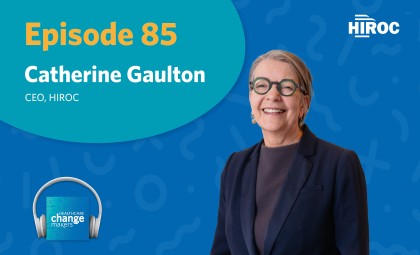
(Access show transcript) HIROC’s CEO Catherine Gaulton reflects on the past year for HIROC and our Subscribers. She tells us about the lessons she carries with her from her father. Plus, a special guest stops in at the studio.
Summary
Sustainability and shelter, with a good dose of innovation. These are the words that come to mind when Catherine thinks about HIROC and the past year. It is her hope that for Subscribers, when things feel in flux, HIROC is viewed as that calm place in the storm.
Catherine and Philip tease HIROC’s new strategic plan “The Art of Safety”, which is launching in January 2026. Spoiler alert: topics like cyber, perinatal, education, and accessible data are featured heavily in the new plan.
We talk about Catherine’s roots and the lessons she carries with her from her father, especially around there being no limitations to what his kids could do. For Catherine, it’s about asking, “What’s stopping you?” when things get tough.
In the spirit of the holidays, it’s a true family episode as Catherine’s son Thomas also stops in at the studio for a chat. We learn a lot about Catherine from talking with him – including some of what makes her a classic Newfoundlander.
Thomas uses the word “perseverance” to describe his mom. From all of us at HIROC, we concur.
So, we’ll leave this as our challenge to all of you as we head into 2026… what’s stopping you?
Mentioned in this Episode
Transcript
Imagine you could step inside the minds of Canada's healthcare leaders, glimpse their greatest fears, strongest drivers, and what makes them tick. Welcome to Healthcare Changemakers, a podcast where we talk to leaders about the joys and challenges of driving change and working with partners to create the safest health care system.
Philip De Souza: Hey, listeners. It's Philip here. We made it to the final episode of the year. I can't believe it. It's already our traditional end-of-year podcast with our guest, HIROC CEO Catherine Gaulton. Welcome Catherine.
Catherine Gaulton: Hi, how are you?
Philip: I'm doing well. I can't believe we already--this felt like yesterday we recorded last year's end-of-year message.
Catherine: I know. Time is just racing. As I get older, time is moving faster. Something unfair about that.
Philip: Well, let's get right into it. Like I said, we did it, Catherine. We made it to the end of the year, and it's been quite a year. So much happening globally on our continent, and of course locally. And for me, two words float to the surface. Those words are adapting and evolving. So, I guess my question to you is what word or words simmer up to the surface for you when you describe the year and why?
Catherine: So, you know, I think about--and it's boring, but I think about sustainability or shelter. I think when things are really so volatile, they're so hectic that you look for a place in the storm. And I would hope that while we are always changing in order to meet subscribers' needs, that we're also viewed as that place in the storm and where you know what you're gonna get when you go there. You'll know it'd be given with the best of intentions, and that it's informed. That the people on the other end are working hard to make sure that they are able to continue to serve you and that they take the time to listen to you. And to me, that's a big grounding in sustainability stability, you know, with a good dose of innovation.
Philip: Oh, I love that, sustainability, that shelter. That's really cool analogy of, you know, the place to look for in the storm as things are continually changing. And I like how you kind of like in, you know, HIROC and, you know, the word you're using too to that kind of, you know, that space to go to that you can feel--get nourishment from and you can get things from and you can get your answers, and we got your back. I love that, how you brought that together. And you said a couple key words too that kind of piqued my interest because they are in our new strategic plan which is launching in January of 2026. So, Catherine, tell listeners what excites you about our new plan, our new strategic plan.
Catherine: Well, you know me, Phillip. So, everything excites me about our new plan. The fact that we will continue to focus on the things that we know it's important to focus on, those areas of claims and quality in the system, you know, things around what we're seeing most frequently in relation to medical malpractice claims, issues around perinatal care and how we can collectively do better on that front, cyber as a predominant issue for our subscribers, and education. I think on perhaps, you know, what seemed to be a more pedantic level, our intent to focus on how it is that we make our data most accessible, that it's grounded even better in how you can compare, really getting our peer groups right, being able to break down the components of the organizations who are our subscribers so that we can compare different clinical programs and not just at the organizational level.
So, a whole note there. Also just the intent to focus heavily on, what is our model, our financial model? Is it the best it can be for our subscribers? So, on the underwriting matter, sounds really boring, right? But it is so crucial to our system because we wanna make sure that we are adjusting to what the system needs, and finance is a big part of that. And so, lots about that and then lots about innovation. What might be the insurance needs of the future and are we ready for them on behalf of our subscribers?
And then, look, always a huge focus on our staff because that's the right thing to do as always, but also because it's what's really gonna make sure that we continue to serve subscribers in the way that they and those they serve really deserve.
Philip: Oh, very cool.
Catherine: You thought you get a short answer, didn't you?
Philip: No, it's a good answer. I love the points about the kind of, like, democratizing data and making it more accessible to all our subscribers, and in general to the whole healthcare community. I know that that's really important to you and the team here. So, I love that. And speaking of what's important, what's something you personally are proud of from the past year on how HIROC responded to a critical need from the system?
Catherine: Yeah, look, I think there are so many things that are happening. The responsiveness, you know, for cyber, the responsiveness in relation to governance and what is, you know, preoccupying our governors. I just--I worry about that quite a lot because I think in our system, with so many dedicated professionals and leaders. And we have these boards who give freely, and literally freely of their time. And I worry that they worry and I worry that they consider whether it's a good idea for them to go on boards or not.
And so, anytime we're really addressing that need, giving stability and sustainability for those who are volunteering their time in our system in order to give the best, also that they better serve the community of patients and others who receive services through our system. And so, I'm really, really pleased about that. I'm really pleased that we've continued to work in relation to the human resource issues, workplace violence, how we work together to really control that and its impact on our health professionals. And, you know, the education programs, you know, broadening our education programs this year to include a midwifery residency program, to include a perinatal midwifery program are all just really huge. And the fact that this year, we were able to, you know, renew our property program in ways and added coverage and added, you know, diversification and saved money at the same time.
So, you know, you'll have to stop me now, Philip, because I am proud of so many things. I'm proud of what our system is able to do from people, even with all of the stresses that are present in it. And I'm proud of what HIROC's people are able to do for those people and for those organizations and the patients they serve. Patients and others that they serve.
Philip: No, you mentioned a variety of points there, which is great to hear. And I know there's much more. And when I speak of them much more, I know that, you know, just because the person you are and how you interact with our subscribers and leaders across the country, you often get a variety of notes from them where, you know, yes, they're asking questions. But, you know, our listeners don't know because they don't sit next to you like I do. But you also get lots of really nice praise. And so, I know, you know, 'cause you, you know, make a challenge us to this, you know, providing the best service. But then I love it when you pause and you read out, you know, let's say, like, I know you get lots, but you read out one note. And most recently, you read one note to a big group here in a meeting recently. And I saw as you read it, I saw how everyone kind of, like, their eyes lit up and they had all, like, you know, like, smiles on their faces and they were all beaming with joy. And so, when you get those kinds of notes, how do they make you feel?
Catherine: Well, look, they make me proud to be part of an organization and a group of people serving other people that can be viewed that way. You know, I am always surprised by just the unequivocal devotion to subscribers that we have here. You know, we have all the same workplace issues, workload and work-life balance and all those things that all organizations have. But the underpinning of service to others, and in this case, particularly to subscribers and those they serve is huge. And then, you know, so you'd have this impression as you walk about day to day, and then to have it confirmed in conversations. And it comes back to, you know, we deal with really brilliant dedicated people all the time. And when you can be a resource for what that level of dedication and talent is able to do, then it's just absolute reason to be proud.
So, I'm proud to be associated with all of the people in the system that we serve and all of the people here at HIROC. Our board of directors just unequivocally focused on how it is that you make things better, keep things stable, improve as required, all for the benefit of the health system. It's really quite inspiring.
Philip: And this past year in our annual subscriber engagement survey, you know, we asked subscribers to rank HIROC's value drivers. And the top five chosen by them, by our subscribers, were expertise, responsiveness, risk reduction, price and quality. So, what do these drivers mean, you know, to you and how do you factor in as you deliver and guide us, the team here at HIROC, on delivering on our promise to the community?
Catherine: Well, absolutely. So, these values and these drivers for subscribers are the cornerstone of where we start from as we develop strategic plans, as we plan operational planning for the organization. And look, you know, a focus on quality is just, as you know, really near and dear to my heart, really near and dear to HIROC as an organization because our subscribers have said, guess what? That's what's important to us. And so, therefore it's what has to be--what should be important for you.
And so, I think that. And then, you know, we're experts because, of course, we're keen on ensuring that we keeping abreast of what is best practice. We are mostly experts because we have, I hope every day, the humility to be listeners, to be learning from our subscribers, and to be the vehicle to spread that among other subscribers. When I think back over a year and I think about, well, what brilliance did we get from--you know, what do we hear from Newfoundland this year and how has that spread? And what did we hear from Alberta and how have we spread that? That ability to really pull on the dedication and talents of our subscribers and then to spread, I think it's just huge.
So, the expertise, I think, comes from a whole load of places. And then, of course, to be there, to be sustainable, to keep very closely focused on what the needs of subscribers are as we develop. Everything we do, including our strategy, is just fundamental. So, I wouldn't take the first step without knowing what the value drivers are for our subscribers, and on hearing from them about how we can improve. I have conversations every year with a whole cross section of leaders across the country, and they're driven entirely by, what's your context now that we should know? And what can we be doing more off better in? And they have to be the grounding if you're in an organization like ours that is made up of subscribers that is driven by what is important to subscribers.
So, they mean everything, I guess, in the end. Short answer, those values mean everything because they are what our subscribers are looking for and because they are, of course, exactly what we all need in order to really, you know, be successful on this journey toward quality and safety that's so near and dear.
[music]
Philip: I personally know how much you value learning and can see, you know--I can see how it brings you joy 'cause you just love to learn. So, if you could go back to school as a full-time student tomorrow, what would you wanna study and why?
Catherine: Okay, so look, the funny me will say, you know, I wanna do a PhD in fine arts and maybe maybe in wine appreciation. But I am absolutely fascinated by people and by history. And I think we learn so much from that and I think we need to be grounded in history while looking to the future. So, yeah, like I think, wouldn't it be great to just have the luxury of learning what was motivating at the times of history, but also the people in history. I'm just absolutely fascinated by how that drives people.
Philip: Interesting.
Catherine: Still wine appreciation.
Philip: That's a good one too. But it's funny you mentioned that 'cause I'll be asking you somewhat add-on question in the lightning round. Another question I have for you is, you know, earlier this year, you know, we were sad to hear, you know, that you lost your dad. And I know how close you are with family. I know how much it means to you 'cause you got a big family. And so, tell me what's something your dad, you know, told or taught you that stayed with you even till today?
Catherine: So, lots of things. But I'll just say, you know, I have said this to you. My dad's very traditional man with eight sons and two daughters. And I think he had, you know, fairly structured lens about what the differences were. And yet when it came to me and all of my siblings, it was very clear that he knew of no limitations on us. And so, this piece around, I remember doing a recitation in Newfoundland. And my father seeing me after and just leaning down and quietly saying, you were the best. And of course, in the moment, you know, that's what we do with our kids. But that sense of things was exactly where I think the other part, is just this family and service to family.
And one of the most objectional things to my father was that if you were not met at an airport, for example. So, this notion of knowing you're valued in whatever way was just core, and how he valued family, his siblings, you know, my mother and me and my siblings. So, lots learnt there for sure.
Philip: Oh, I love that. No limitations. That's so, like, barrier-breaking right from the start to, like, let you and your siblings know that there's no barrier that you all can't overcome. I thought that's a good--that's such a nice message.
Catherine: Yeah. Dad would never, you know--he would never say no limitations. He'd say, what's stopping you?
Philip: Yeah, what's stopping you?
Catherine: In a Newfoundland accent.
Philip: And I see that today, even through, you know, when you challenge us in meetings or, you know, asking us, you know, like, whatever the task is, you do that. That's funny that you said it that way now 'cause you do ask that question, like, what's stopping us? You know, like, how can we drive it forward? And so, it's so nice to hear that, you know. I know I asked you this question now. And as we talk through it, I could see you doing it too. That's lovely to see.
Catherine: Thank you.
Philip: HIROC is so lucky that you and we get tapped on the shoulder, often by, you know, people who we don't--who we may not even be serving or, you know, they may not be our customer, for example. So, when those things happen, like, how does that make you feel that, you know, we are being called upon by whomever? It could be government. It could be other healthcare providers. It could be groups, whatever the case may be. Like, how does that make you feel that, you know, kind of, our name, our reputation stands on a different type of, you know, kind of, you know, podium, so to speak?
Catherine: Yeah, no. And look, Philip, I think you have to take a lot of credit for making it apparent to others what we know about HIROC and I hope what our subscribers know about HIROC because, you know, we're just getting that message out so much more. And I wanna get the message out because I do think there is a huge amount that we have available that should be available to the whole system. You know, it's great. Of course, it is available for subscribers, but imagine what we learn from subscribers that should be available to the rest of the system?
So, it makes me feel great that that kind of move from what we are trying very hard to ensure we have ourselves, whether that's on insurance and healthcare safety and claims and risk management and finance and the whole gamut of that, that it's recognized so that people can access us. I mean, and the biggest thing about that is that it's useful, that someone sees that it can help to move the mark on something that they're trying to do. And I just think that's phenomenal. It's really about that. What's the goal? You know, what's the goal of being known and recognized? It's really so that you hopefully can have impact across the whole system that you're trying to positively impact and that your subscribers are asking you to.
Philip: I love it. And I must say, I know you're trying to be too kind and putting it back onto all of us, but because people have access to you and, you know, you've been in the system and in different parts of the systems, that also, I must say, adds into the fact that people come to talk to us at HIROC for a variety of--seek out a variety of advice and counsel. So, you have to take credit for that too, Catherine.
Catherine: Well, I'm old, right? So I've been here.
[laughter]
Philip: Before we get to the lightning round, I'll ask you one more question. As we move into the new year and, you know, 2026 is just around the corner. This doesn't have to be about work, but what are you optimistic about?
Catherine: Oh well, look, I have so much that's--I have so much that's phenomenal. You know, I have--you know, my family is amazing, just absolutely amazing. And I have loads of plans in the new year to do things together. You know, one of my sons is getting married and it's a destination wedding, and I'm so thrilled about who's entering our family and who might be entering our family in the future there to our other son. But this opportunity of an away wedding to just hunker down with each other for seven days.
I am also just looking forward to travelling this country. Our board's gonna be having a retreat in Yukon. And I really do think that this is a year when we're gonna see change, and at the same time as stability in the system, so that I think my rose-coloured glasses perhaps or that things will settle so that we'll be able to make the changes and to move the mark on things that we've been trying for a few years to really make. And when I say we, I mean the collective of the health care system. So I'm looking forward to it.
You know, I wake up every morning thinking we're gonna solve all the world's problems in that day. But I actually do think that there's a lot to be excited about our strategic plan. Too many things, Philip. But, of course, the opportunity to really spend concentrated time with those who are most important to me is huge.
Philip: No, it's fantastic. And listeners, I'm gonna try my hardest to get to that destination wedding too, then maybe interview Catherine in a new location to hear how if any of her responses change when she's on vacation. So I can't wait for that.
Catherine: Yeah, not at all.
[music]
Philip: Well, now, it's time for the lightning round. There's a few questions for you. You can answer one word or a sentence or as long as you want. So, what are you reading or watching? What's consuming your time these days outside of work?
Catherine: Yeah. So, I'm reading a--I've been reading lately a lot of, like, the Pearl S. Buck kind of genre, which is really about the place of women in very historically under--well, where women are viewed, let's say, not at their full potential. And yet these books are written from the perspective of almost this second culture or something where you're able to make change within the constraints. So, a lot about women in very cloistered, historic Chinese environments, for example, where they are in fact, phenomenal practitioners in healthcare. And it's really cool. It's really cool. And yeah, I have a bit of a focus. But if you think about the genre being sort of like the Pearl S. Buck kind of genre, but some new authors in Canada who are writing in that regard.
Philip: Yeah, that sounds cool. What are your holiday plans?
Catherine: So, all of the--everybody is gonna be here in Ontario. I'm always thrilled when we get to stay in Ontario because, as you know, we have a place in Nova Scotia and it looks to be, you know, the place to be. We can have a bigger Christmas tree there, all that kind of thing. But everybody will be here. And again, I'm just looking forward to hunkering down with low stress and spending time with people.
Philip: That'll be nice and special. We've had some fun with this question, and it kind of ties into what you said earlier. But if we let you get into Michael J. Fox's DeLorean from the Back to the Future movies, what day, year, or time period would you wanna go to and why? What would you enter onto that date thing?
Catherine: Yeah, no, it's so tempting to think about going back to when my kids were born, you know, but then I'd have to do, you know, do two places. And just this notion of absolutely, you know, falling in love with people. And in the same, of course, when I met my husband. But I'd actually choose something in the future, which, for a person my age, I should be trying to stay put rather than, you know, wait and lose time. But I have this absolute sense that we're on a path where things will feel better and where the system will have leveraged AI effectively and appropriately. And it's helpful rather than issue--rather than creating issues for those we serve.
So, I would say I wanna stay the same age or younger than I am, but about five years from now.
Philip: Okay, everyone, we have a very special guest who just joined the studio. It's Thomas. It's Catherine's son. Welcome, Thomas.
Thomas: Thanks. Good to be here.
Catherine: You keep asking my children on today's podcast.
[laughter]
Philip: I know. I like to surprise you. Thomas, why don't you tell people just so they know, you know, where you're calling from and what you do?
Thomas: Yeah, sure. I'm calling from Montreal, and I'm a data scientist here in Montreal with Deloitte.
Philip: Very cool. Well, thank you for taking a short time. I only have a few questions for you. The first question is, what's something your mom has taught you that stuck with you even to today?
Thomas: Yeah, I think a lesson that she's taught me is just sort of always to be open to new experiences. Like as a child, there are many things I didn't wanna do, but she would still force me to do them. And they'd end up being like really great experiences. So, I've always taken that with me just to be open to trying new things.
Philip: Very cool. And Catherine, do you see him--do you see that follow through?
Catherine: Yeah, well, absolutely. Thomas these days is so open to experiences. It's a pleasure to watch, whether that's food or travel. Loads of things. There's an experience of when Thomas didn't wanna play soccer. And I said, well, there are consequences, you know, of not joining things when you've started them. And so, I think you'll have to think about that in your room. And instead of capitulating, he just turned on his heel and went to his room. And so, we really--David and I always really appreciate it that he did try new things, but he was also willing to stick to his own guns when he felt strongly about something, so.
Philip: That's nice. And you know what, another way your dad shines through is 'cause you kind of--well, you told him in a different way, is what's stopping you? Thomas, what's something that makes your mom laugh out loud?
Thomas: I think the biggest thing is just any sort of, like, Newfoundland-related humour. There's, like, this show called Hatching, Matching and Dispatching. And every time she watches that, she's cracking up. Just the Newfoundland style of humour and the slang and, yeah, I think anything like that.
Philip: That's funny. Is that accurate, Catherine?
Catherine: Oh, yeah, yeah, yeah. You gotta see that show. And, you know, and look, I like slapstick. And we like it together, like the whole family does. It works.
Philip: Is there a special--Thomas, is there, like, a special movie or TV show that brings back memories from when you were younger that you would watch with your mom?
Thomas: I think we would watch, like, some crime shows as well. CSI was a big one. When I was really young, I think, like, we mostly just watched children's shows like a Big Comfy Couch. But, yeah.
Philip: Thanks.
Catherine: Land Before Time. Remember that?
Thomas: That was a good one.
Catherine: Arthur.
Thomas: Yeah.
Catherine: And then Power Rangers that I wouldn't let you watch for a long time.
Thomas: Yeah.
Philip: And I always teach your mom about favourites. But who's your mom's favourite? The dog, your dad, your older brother Ben, or you? Who would you say?
Thomas: I'd have to say me, I think. Maybe Caval, our former dog. But he might be the competition.
Philip: And she very much loved your mom, I think. Because of her love for Caval, I was like, oh my God, this dog is amazing. But that's sweet. And why would you--and what would your brother have to say by you saying it's you?
Thomas: I think he'd agree. He always says it.
Philip: Oh, I should have seen. Now, I realized 'cause I always tease her and she'd be like, Philip, I do not have any favourites.
Catherine: Yeah, Ben's quite a kidder though. We don't, you know.
Thomas: That's the real answer. No favourites.
Philip: And I asked this to your brother before. What's, you know, I guess dinner time conversation that amuses you, obviously, when your mom's around? Is there anything that comes to mind?
Thomas: I think if my mom and my [inaudible], they'll have some intense legal discussions that no one else can follow, but always funny. Get into a little debate or something.
Philip: You don't include Thomas in these legal business?.
Catherine: Well, you know, Thomas and I are more considered in our discussion. And we have them in lots of ways. Thomas and I have conversations when we're both up late at night. And so, it's just different, you know, but we have lots of great conversations at our table. We deal with a lot of world issues. And Thomas and David talk lots of science that sometimes Ben and I don't get.
Thomas: I think you understand most of the science, but we also talk about health care. That's sort of interest of mine. So, yeah, I'm definitely interested in healthcare as well. So, I learn a lot about different things going on in the field from my mom as well.
Philip: Very cool. And my last question to you before we ask Catherine her last question is if you had to describe your mom in one word, and I guess you could, you know--since you're the favourite, I guess I'll let you add in a few others if you need to. What word or words would that be?
Thomas: Hmm, I think, like, a big word is perseverance. Like, she's just always working hard, always, like, not giving up on any task. She's just so dedicated to anything she does. Like, she just, you know, will not rest until she's sort of achieved what she needs to do. So, I think that's a big one. Yeah.
Philip: Oh, it's a very fitting word. That's a nice way. Thank you for adding that. And Catherine, my last question for you before I let you both go, you know, as we close our chat here today and with our very special guest, too, Thomas. You know, I was watching a video recently with Brene Brown. And in it, she was talking about the importance of, you know, courageous leadership. So, you know, why is being, you know, courageous important for you? And I guess, you know, I guess it could extend to Thomas 'cause he's pretty courageous himself.
Catherine: Well, I think--you know, I hope that just like I sort of got it at my father's knee, I guess, is that our children and Thomas and Ben both certainly exemplify this. This notion that if it's worth something, then you can't be inhibited. So, you know, if you come back to the sort of theme of what's stopping you, you have to assess whether what's stopping you is something you can live with. And in the end, if it's important and you don't pursue it, then you have to take the consequences of always thinking, you know, the what ifs.
And I worried in my life about the level of courageousness. But I've been extremely lucky both in my personal life and in my work life that if I'm doing things that look courageous to others, they're coming from a passion that people can appreciate, I guess. And so I just think, you know, when--there are lots of things I'm not courageous about. But when something's important, and I hope I am courageous. I may not always be, but I hope I am. And I see that in both of our children to just being very clear about what's core and what's part of the principle and what's part of our value system. And then for that, there may be some consequences, but they're worth it. So, you know, it's certainly what I see in in my children. So, I hope others see it in me too.
Thomas: I think that goes back to my first answer as well, about, like, being open to trying new things. I was just, like, the pickiest child ever, would not eat anything. But now, I'm, like, open to pretty much any food. So, any experience, I think that's how I've learnt courageousness as well through my mom.
Philip: That's very sweet. And you're both absolutely right, 'cause I've seen, you know, Catherine's, you know, courageous leadership in action at work. And, you know, it's safe to say that it's rooted in a deep value system, Catherine. So, I see that in every interaction and how you make decisions and how you lead and. And Thomas, I've been lucky to, you know, chat with you and be with you a few times. And I know that you portray courageous, you know--you have courage as well, because, you know, for example, you know, like what Catherine said, you lead with empathy. I can tell, 'cause people come to you on the subway or in the library or on the street. And I don't think that would be the case if you didn't have this approachability to you and this, you know, abilities to be empathetic and, you know, listen to people, no matter who they are. And I think so. It's clear to me that you both have it in you. And Catherine, obvious of course, you helped teach that to Thomas. And you may not realize it, but you also teach each of us here at HIROC every day about that as well. So, with that said--.
Catherine: Thank you, Philip. Yeah, thank you. Thank you for this and thanks, Tom, for coming on. You tell your employer that you're making time in the middle of the day to be doing that.
Philip: Yeah, you can tell--that's right. You can tell your employer that you're not moodleting on a podcast. It's a family podcast. You can say that 'cause you're family. So, thank you, Catherine. Thank you, Thomas, for being our special guests on this show, and we wish you all the best over the holiday season.
Thomas: Thanks so much. You too.
Catherine: You too, Philip. Thank you so much, Phillip.
Thank you for listening. You can hear more episodes of Healthcare Changemakers on our website hiroc.com and on your favourite podcasting apps. If you like what you hear, please rate us or post a review. Healthcare Changemakers is recorded by HIROC's communications and marketing team and produced by Podfly Productions. Follow us on Twitter at @HIROCGroup or email us at [email protected]. We'd love to hear from you.