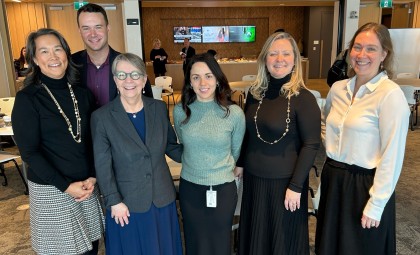
Peterborough Regional Health Centre (PRHC) leads the way in finding opportunities to partner with purpose around all things AI.
What do you get when you bring together health system leaders to talk about AI?
Well, we saw firsthand the drive, determination and candor – we saw the art of the possible. And it was all thanks to Dr. Lynn Mikula, President and CEO of Peterborough Regional Health Centre.
Together with partners from KPMG, Microsoft, and HIROC, the interactive meeting on February 19 saw for valuable knowledge sharing. This is something we at HIROC value and which is in our DNA – sharing the brilliance of HIROC Subscribers across the sector (it’s also the HIROC advantage). And it’s this exact forward momentum we witnessed as partners as the community came together to craft a Health Workforce AI Playbook at the meeting.
Right out of the gate it was clear Dr. Lynn Mikula understood that this is a journey happening alongside the realities our system is facing. Here are just a few of her inspiring words to the room:
- “I’ll be honest, I initially approached AI as just another tech thing which I felt was overhyped and not really a healthcare support. But I’ve always cared about data, and we in healthcare have so much of it. And then it hit me that AI can help manage this data as words, images and more to pull in and analyze all of it with the goal to help us make better decisions and take action. It’s here I realized it can change everything.”
- “We’re at an intersection of forces. Whether it’s the aging population who will need more care, a growing younger workforce coupled with a high rate of longer tenured experienced workers retiring from the sector, and the ever-evolving complexities of the healthcare system. We just need to really think on how we can maximize human potential and time.”
- “The problems before us in healthcare will be solved by the people in this room, by our community – and we’ll do it one challenge at a time.”
AI Strategy in Action: A PRHC Talk
Co-piloting the journey at PRHC and a featured speaker at the event was Evan Lyons, Vice President, Digital Information Services and Chief Information Officer at PRHC. His talk painted a vivid picture of how action can lead to progress with purpose.
We caught up with Evan after the event, and he shared his five key takeaways from the day:
- It’s clear that hospitals and other healthcare organizations are eager to tackle the complex problems of workforce planning, data, and analytics in the age of AI, however many are still working through the logistics of doing so. Hearing the various perspectives in the room, I think the realization of the achievable value is there, and I’m glad to hear that work is underway to understand the risks, including how teams are identifying the pros and cons of moving forward, or inversely not moving at all.
- I was so energized hearing the desire that many in the community are open to partnering to support making an impact in this space, and many at the event were already organically connecting and arranging follow-up collaborations all with the goal of working to solve problems together. It was great seeing there is collective optimism and how we’re all empowered to find solutions together.
- The only truly sustainable path forward is one of collaboration. This includes sharing insights and human resources with one another to allow for maximal skill blends without exponential or redundant costs. Beyond the people sharing is the sharing of technical designs, ideas, policies, processes, procedures, best practices and deployed production technologies themselves.
The more we can focus on reusability, the better. We are solving common problems regardless of organization size, and if we build the right modular solutions, we can continuously improve and adapt them to meet varying needs across the sector.
- You do not need to be big to do big things! Small, medium, community hospitals and healthcare organizations can be innovators too, and are often nimble enough to solve highly complex problems. Innovation must be democratized to capitalize on the promise of today’s technologies, and today at the event, I saw firsthand the power of that spirit.
- Let’s focus on how this collective path forward with technology is one that is centred around humans and change management, and realizing how any technological solution is one that supports rather than the inverse. Problem first, then solutions! Sit in the problem and truly understand it.
“An important lever to support the change is being able to answer ‘What’s in it for me? What does it mean for me?’” said Evan. “And being clear and transparent and focusing on the value everyone will see.”
Evan’s candidness was welcomed by the capacity crowd. “It’s okay to communicate that we’ll never get it perfect, because if you say it’s perfect and it’s not, you’ll just be eroding trust,” he added.
Evan emphasized open communication and a dialogue with your people. He anchored that in the 4 Rs of focus:
- Reason – the undying why
- Readiness – measured, not assumed
- Realign – listen to friction and don’t be discouraged, but rather lean into the fact that people are actually interested in what you want to accomplish
- Reassure – guardrails matter
But what we so greatly appreciated was his final point on partnerships.
“Your partnerships are likened to a force multiplier,” Evan said. “They extend capability without duplicative platforms or work, and shared data estate becomes a research powerhouse with a comprehensive system-level lens on healthcare and not just what’s happening in our four walls.”
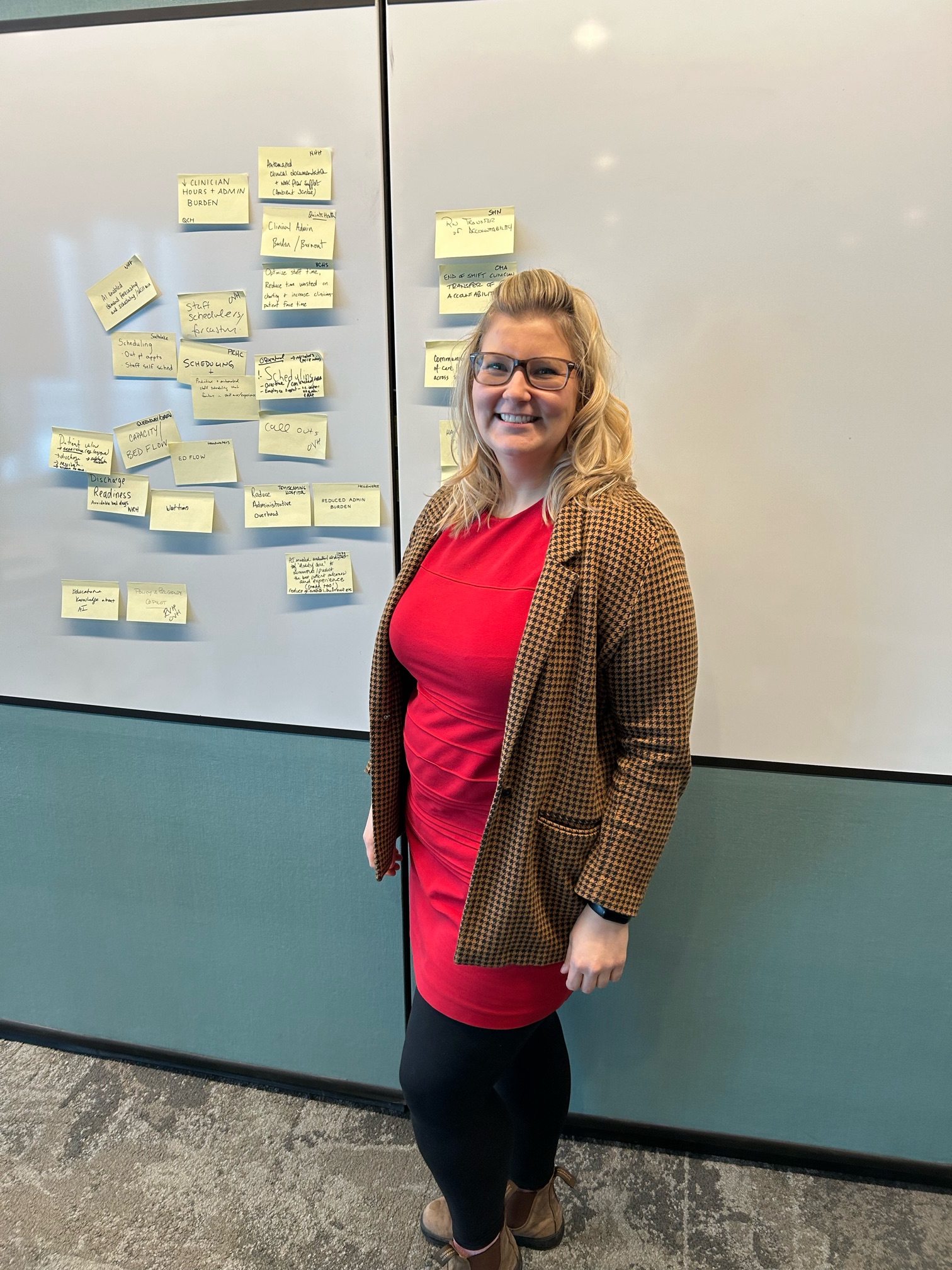
Clearly Evan and Lynn’s messages hit home with attendees. “We can’t overestimate the collaboration and intelligence we have among us,” said Lindsay Wyers (below), Vice President of Digital Transformation and CIO at Queensway Carleton Hospital. “I’m leaving here today feeling inspired and motivated. And because of the connections made I’ll be thinking more on how I can leverage partnerships with people who have already started on their journey.”
Context Setting: A KPMG Talk
Michael Allen, Partner at KPMG UK, started his talk by spotlighting the notion, “Is AI hype or reality?” He showed two pictures, both taken in the exact same spot on a busy street in New York City. One was from 1913 when the horse and buggy were the prominent mode of transportation, and then a picture from 1923 (just 10 years later), where the automobile had now revolutionized transportation in the big city. It was a fitting parallel to what we are seeing in the present with AI advancement and adoption.
Michael highlighted several prominent types of AI in healthcare and shared just a few examples from each. They included:
- Agentic AI = patient care coordination, scheduling, booking patients
- Generative AI = generating content on LLM, supporting the discharge process
- Ambient voice technology = clinic notetaking and diction, handover transcription
- Predictive AI and analytics = population health management, capacity demand modelling
“We were fortunate to partner with the Leeds Teaching Hospitals Trust and uncovered a lot of insights,” said Michael. “One example of a game changer when it came down to who would be best suited to benefit from AI… was midwifery.”
Michael shared how they sat down and spoke with midwives to hear how they spent their day. They realized generative AI could support data interpretation and content creation, to name a few. And ultimately this would give midwives more time back to spend with clients.
He advised the crowd to establish centres of excellence (CoE) to help effectively implement AI. The CoE would also serve as a body to oversee, expedite and expand AI implementation. It would also help deliver standards and best practices and provide a governance framework.
Michael closed his talk by challenging leaders to think about practical issues now, such as:
- AI value = readiness assessment
- AI enable = thinking about data architecture and platforms
- AI trust = ensure there’s board oversight, AI governance and regulation
- AI workforce = provide opportunities for learning and development and think about workforce design
HIROC’s CEO Catherine Gaulton added a crucial point as organizations get moving on Michael’s steps, “It’s important to define the problem you want to solve before you start.”
A Framework for Success: A Microsoft Talk
“If we get together and think collectively, we can make better systems,” – that’s how John Doyle, Global Chief Technology Officer, Healthcare & Life Sciences at Microsoft, kicked off his talk.
He shared a great success framework, which included:
- Enriching employee experience
- Reinventing customer engagement
- Reshaping business processes
- Bending the curve on innovation
John also pointed to the commonality of patterns in healthcare and the value in unlocking innovation with every layer, while simultaneously meeting security and privacy concerns.
“It’s about delivering value and not creating more complexity in the system,” John added. “AI is already transforming healthcare and, as Lynn said at the start of the day, data is the foundation for improving patient outcomes, enhancing clinician productivity and improving the experience for everyone.”
And John’s personal call to action: “Give people the tools – it will likely help lead to bringing joy to their work.”
A big shoutout to Lynn, Evan, and the entire team at PRHC, plus our friends from KPMG and Microsoft. The community appreciates your leadership in making real progress and action in this space.
And be sure to hit follow or subscribe wherever you get your podcasts as we'll be having Lynn and Evan on our podcast Healthcare Change Makers real soon to keep the conversation going!
By Philip De Souza, Vice President, Communications and Marketing at HIROC