HIROC Subscribers come together for a masterclass in good documentation.
Documentation in healthcare is a big topic. That’s probably an understatement for anyone who works in the field. And it’s why we saw over 800 providers and leaders register for HIROC’s recent webinar, Documentation Fundamentals and Practice Considerations for Healthcare Providers.
For HIROC, as an insurer, yes we’re looking at documentation and how it supports in the defense of a claim. But what really came across in the webinar, is how documentation is part of good care and treatment – full stop.
“Of course there are many good reasons to document,” said Gordon Slemko, HIROC’s General Counsel, in sharing that the primary reason is to facilitate communication among the healthcare team, “The team needs to know how the patient is doing to make appropriate care decisions.”
“If you do that well, it actually does also serve the legal purpose – those things line up wonderfully,” said HIROC’s CEO, Catherine Gaulton.
Gaulton welcomed Subscribers and reminded them that HIROC is here for them, to facilitate these learnings and support with any questions.
This piece around sharing and scaling lessons learned is all a part of HIROC’s unique model, the Reciprocal model. “What makes this so powerful is that coast to coast, we’re stronger together,” said Trevor Hall, Vice President of Healthcare Safety and Risk Management.
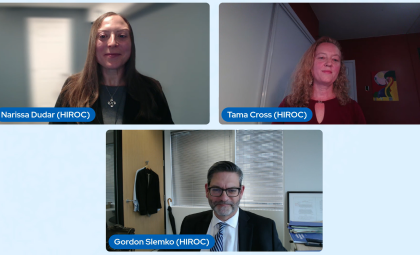
Slemko was joined by Senior Healthcare Risk Management Specialists, Narissa Dudar and Tama Cross to walk through a case study, and share elements of good documentation.
There were many good takeaways from the talk. Here are a few:
- Good notes show what you knew, when you knew it, and how you responded.
- When charting, think beyond recording your findings – try to really capture your clinical thinking as well.
- Keep notes specific, person-centred and updated in real time.
- Remember that re-assessments are just as important to document as those initial assessments.
- Document client or patient behaviour in a factual and non-prejudicial manner.
- Keep documentation as contemporaneous as possible. This means charting regularly and frequently, not charting in advance, and limiting late entries.
- Carefully review all documentation prior to authenticating in the Electronic Health Record (EHR).
Specific to informed consent, the team shared these important reminders:
- The record must show the client understood the information, had a chance to ask questions, and that their values and priorities were considered in the decision-making process.
- Discussions should be thoroughly documented and anchored in the clinical context.
- Any foreseeable outcomes with both accepting and declining treatment should be documented.
- Include questions clients ask.
In today’s landscape we couldn’t talk about documentation without talking about considerations around EHRs. Subscribers must be aware of the metadata that is built into their EHR around time stamps, edit logs, access records, copy/paste indicators, and more. “All are discoverable in litigation,” shared Dudar.
While documentation and doing it well may seem daunting for providers who are already juggling so much in a day, what Slemko, Cross, and Dudar left Subscribers with is the message that we are in this together.
If you have questions, email HIROC any time at [email protected].
We are here for you.
Before you go… check out HIROC’s documentation resources
One of our top-downloaded resources is the Risk Resource Guide, Strategies for Improving Documentation. This resource continues to serve Subscribers in sharing elements of good documentation, and electronic health record considerations.
And on YouTube, two of our most-viewed videos from the last few years are also on documentation, featuring Catherine and Gordon.