Thank you to the team at Hamilton Health Sciences for sharing your safety story with our Subscriber community. Through sharing experiences and successes, our Subscriber community can scale learnings across the Reciprocal. If your organization has a story, reach out to us at [email protected].
When 85-year-old Mary-Jane Dolbear had a serious fall outside the grocery store a few months ago, she was expecting to recover from her broken bones and bump to the head in a hospital bed. Instead, thanks to a new program at Hamilton Health Sciences (HHS), she’s doing most of her healing in the comfort of her own home.
“I never imagined I could get this level of care at home.”
Dolbear is among the first patients to benefit from HHS@Home, a provincial program that provides care in the community for patients who no longer require acute care but still need significant medical and social supports. The program aims to relieve pressure on hospitals and improve patient outcomes by expanding high-quality care into the community.
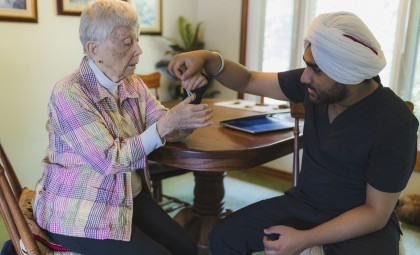
“I never imagined I could get this level of care at home,” says Dolbear, a mostly-retired piano teacher. “There were nurses, physiotherapists, and personal support workers. And I even had help with setting up special equipment. It was all arranged for me.”
Through HHS@Home, Dolbear had access to 16 weeks of home visits from a multidisciplinary care team and the equipment she needed for a safe recovery, all at no cost to her. She got treatment for her injuries and also for her arthritis, to help keep her strong and at home. Her experience reflects the program’s purpose: to provide wrap-around services to support a patient’s transition from hospital to home and optimize recovery in the most appropriate setting.
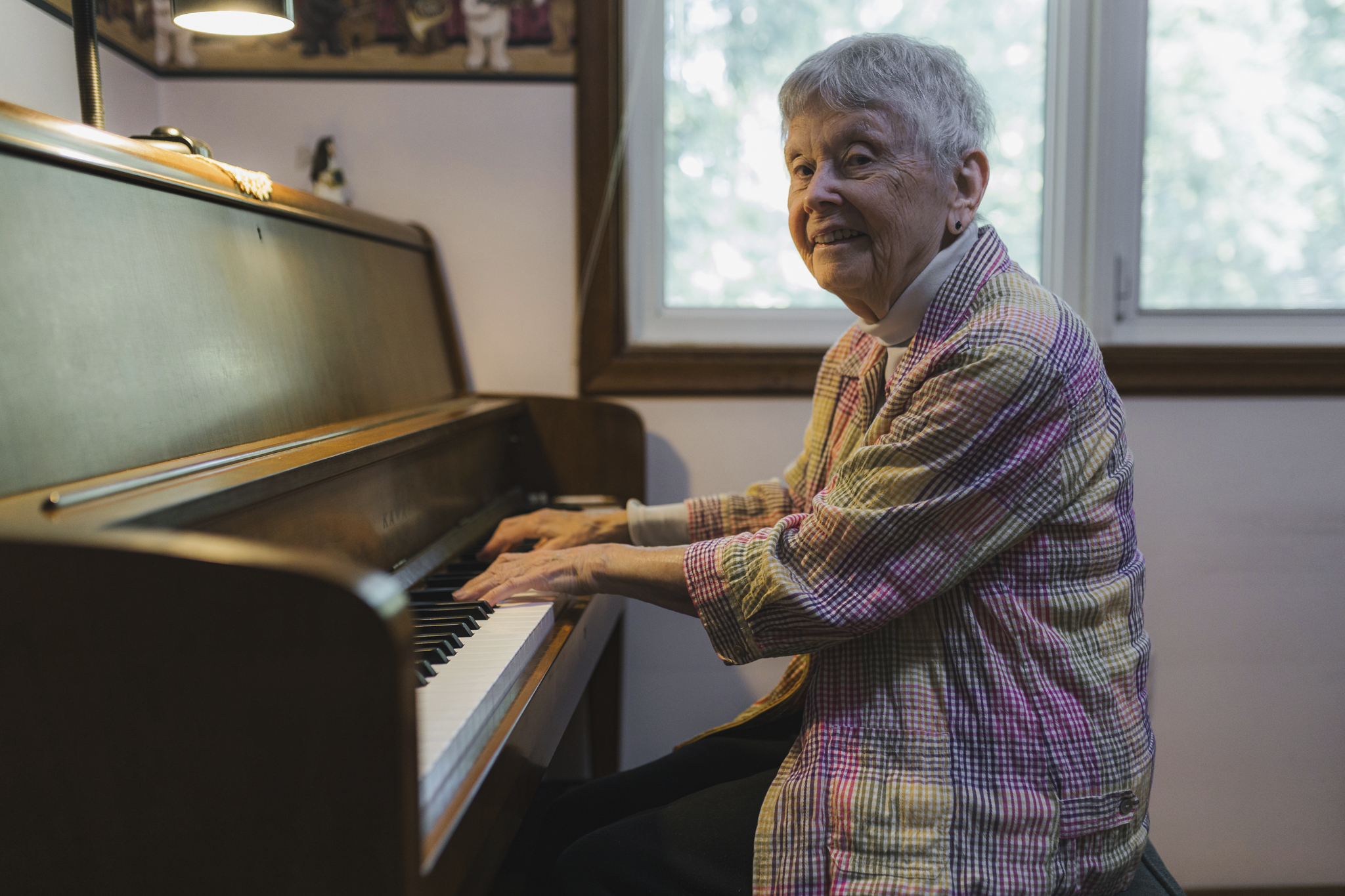
Mary-Jane Dolbear was able to leave the hospital and get back to playing piano thanks to care she received through Hamilton Health Sciences’ new program HHS@Home.
Filling the Gap Between Hospital and Home
HHS@Home serves patients who are medically stable enough to be discharged but still require substantial follow-up care to get back to their regular lives. Under the leadership of HHS, care at home is provided through a partnership with Bayshore Integrated Care Services, a home and community service provider.
In addition to home visits by nurses, personal support workers, occupational therapists, physiotherapists, respiratory therapists, dieticians, social workers, and more, the program also covers equipment needs for the first 30 days, such as commodes, walkers, and bath chairs. This practical support can be the difference between a safe hospital discharge and a readmission.
Fabiola Tapia Lopez and Ashley Eykens are HHS@Home Navigators. Through discussion with the care teams, patients and families, they determine the type of care needed and arrange the right care for each patient through coordination between the hospital and community providers, including Bayshore.
“Often the challenge is making sure patients have the equipment and follow-up care arrangements they need before going home,” Tapia Lopez explains. “This program solves that.”
Benefits for Patients and the System
Since launching in fall 2024, more than 500 patients have successfully left the hospital for care at home through HHS@Home. The results have been overwhelmingly positive, both for patients and hospital staff eager for a new discharge option. At HHS, the program has received funding to expand from Hamilton General Hospital to Juravinski Hospital and Cancer Centre in 2026 as well.
The impact on the broader system is equally important.
By helping patients safely leave the hospital earlier, HHS@Home reduces Alternate Level of Care (ALC) pressures, which are a significant issue in Ontario hospitals where beds are occupied by patients waiting for discharge supports. In addition, the program has resulted in fewer people coming back to the emergency department for care, and fewer hospital readmissions.
Nate VandenDool, director of the Systems Integration Program and HHS@Home program lead, is thrilled to welcome this program to HHS.
“Many patients want to receive care right in their homes,” he says.
“This program allows us to better serve our patients in care settings that match their functional needs, while at the same time improving our ability to address capacity challenges in our acute care hospitals.
We are excited for this transformational opportunity to take a key role with Ontario Health in providing innovative ways of delivering care outside of the hospital building, and optimizing the patient, family and health-care provider experience.”
An Off-Ramp to Home
Meaghan Myers is a physiotherapist who works on the spine and orthopedic unit at Hamilton General Hospital who often refers patients to the HHS@Home program.
“I love referring patients to HHS@Home,” says Myers. “I introduce it to my patients as a rehab program at home, where you don’t need to be in the hospital as long as you have enough support in your home environment and can safely return. Now we have an off-ramp for people who have been waiting for rehab or can recover at home.”
“HHS at Home is a great option for people like Mary-Jane,” says Myers. “Patients get access to therapy when their needs are highest – immediately after discharge from hospital. And care plans are tailored to patient’s goals over time. The 16-week program is perfect because patients get all the help they need for the time the need it, from a variety of health-care providers working on the same team to help them reach their goals.”
Positioned for Growth
The program started in the General Internal Medicine units at Hamilton General Hospital and has already expanded to other units, including surgical patients, and will be rolled out at the Juravinski Hospital and Cancer Centre in the new year.
Since the beginning of the program at HHS in November 2024, the program has helped keep people out of the hospital by having fewer people coming back to the emergency department for care, and fewer hospital readmissions. The program strives to enhance patient and caregiver experiences, improve system efficiency, and address the growing demands on the health-care system.
A Strategic Innovation
Developed under Ontario Health’s direction, HHS@Home aligns with provincial goals to modernize home care delivery, reduce hospital congestion, and improve patient satisfaction. With its early success and potential for growth, the program positions HHS as a leader in delivering community-based care.
“This isn’t just about discharging patients,” emphasizes Vandendool.
“It’s about ensuring we have the right care in the right place, at the right time, and doing it in a way that feels seamless and supported.”
For Dolbear, that meant being able to continue teaching piano while she recovered. It’s a small but meaningful sign that the future of health care might just feel a little more like home.
Congratulations to the team at HHS for their work toward safer care by helping patients safely leave the hospital earlier.
If your organization has a story, reach out to us at [email protected]. Together we can turn the corner on patient safety.